Email Us
 Freight Forwarding Software
 Warehouse Management System
 Transport Management System
 Moving/Removal Software
 Service Portal
 Move Survey Quote Pro
 Digital Logistics Inventory App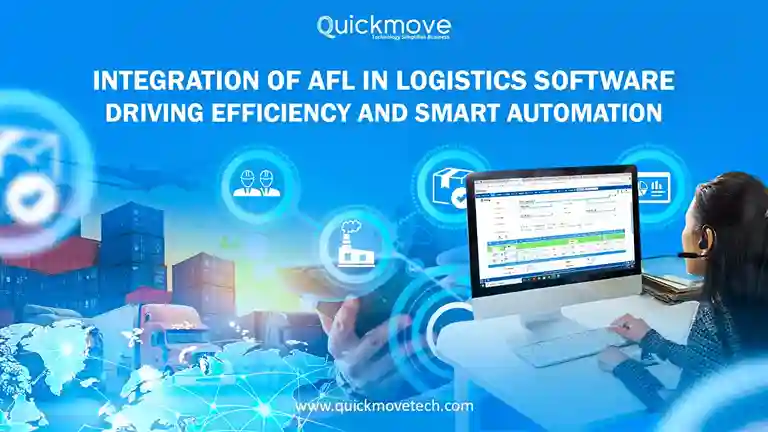
In a time when logistics operations heavily rely on data accuracy, intelligent automation, and instant decision-making, Automata and Formal Languages (AFL) have become a key factor in the emergence of system intelligence. By utilizing AFL concepts, logistics software can not only design the complicated process but also impact the logic of the procedure and confirm that every transaction and alteration in the state is done according to well-defined rules.
Simply put, AFL makes logistics software “think” and “decide” logically — thus, the automation is not only faster but also more intelligent.
- Understanding AFL in the Context of Logistics –
Every process from shipment creation and approval to delivery and billing can be seen as a logical state machine when these ideas are implemented in logistics. Hence, logistics systems can check the data automatically, perform the right actions, and avoid logical mistakes such as duplicate invoices or skipped approval steps.
- Why AFL Integration Matters for Modern Logistics Software – The traditional logistics systems mostly depend on the linear programming or rule-based logic, which can become unmanageable as workflows expand. AFL brings structure, precision, and scalability.
Main benefits of AFL integration are:
- Workflow Accuracy: Each shipment, invoice, and job follow the defined states — for instance, created → Verified → In Transit → Delivered → Closed.
- Error Prevention: The invalid transitions (e.g., closing a shipment that is not delivered) will be stopped automatically without any human intervention.
- Data Validation: AFL uses formal grammar to make sure that data formats and document structures are in line with operational standards.
- Predictable Automation: The simulation of the possible states before the execution can lower the chances of unexpected results.
- Scalable Logic: If new modules (e.g., transport, warehouse, CRM) are brought in, the AFL-powered workflows just adjust to the new situation without affecting the existing automation.
To sum up, AFL integration is like giving the logistics software a brilliant mind which can logically and consistently think through different process combinations.
- Real-World Applications of AFL in Logistics – These are the ways AFL improves logistics automation and decision-making systems:
- Shipment Lifecycle Automation: Each shipment is allowed to perform only the next step of the sequence of states. Automata make sure that transitions occur if and only if the conditions are met (e.g., delivery must be confirmed before invoicing).
- Warehouse Process Validation: The rules of the formal language verify the correctness of the SKU entries, pallet codes, and the data of storage – thus there will be no mismatches of any kind.
- Dynamic Trip Management: The real-time status changes like Loading → En Route → Unloading → Completed that take place without manual triggers are determined by the logic of automata.
- Error-Resistant Billing and Documentation: Through grammar validation, the system makes sure that invoices, e-manifests, and ZATCA e-invoices adhere to the standardized structures.
- Smart Exception Handling: The AFL models that can detect the irregular state transitions (for example, missing PODs or duplicate routes) and make the alerts go immediately.
How QuickMove Implements AFL Concepts – The QuickMove Logistics Software Suite has been conceptualized with the intelligent workflow automation at its very core which is basically the implementation of AFL concepts. The Freight Forwarding, Transport Management, Warehouse, and CRM — every module is built with the help of the state-driven logic model thereby ensuring both data integrity and workflow compliance.
QuickMove is actually a real-world example of which way AFL is used by:
- State Machines for Job Flow: Each work order is transferred to the next stages of the automated flow according to conditions that have been set by the system.
- Formal Grammar in Data Structures: Validation inputs for various types of documents such as invoices, quotations, and stocks are taking place to ensure trouble-free data entries.
- Automated Transitions: The QuickMove digital apps (Survey app, Inventory app) that intervene during the time of the event actually trigger the workflow transitions — for example, the invoicing will be activated automatically by “Delivery Completed”.
- Process Consistency Across Modules: Irrespective of whether it is CRM → Operations → Accounts, the system will carry out the AFL-defined tasks in the right order.
In this way, complex logistics processes are at the fingertips of every QuickMove module that works universally in the automation of validation and strict control.
The Future of AFL in Logistics Automation – With the transition of logistics into an AI-driven ecosystem, AFL would be the basis of machine learning models, predictive automation, and intelligent decision trees. Moreover, the interpreting of complex scenarios will be done by the systems, apart from just automating the tasks – this will include the understanding of context, exceptions, and future outcomes.
This is the kind of change that QuickMove is leading and that uses AFL-based logic to offer logistics companies that are smarter, quicker, and more reliable. By combining the theoretical side of computer science with the practical side of logistics, QuickMove ensures that precision, compliance, and real digital transformation are reached by businesses.
Conclusion
The integration of AFL into logistics software is more than a mere automation — it is intelligent automation. With QuickMove’s AFL-driven design, logistics companies can enjoy higher operational efficiency, lesser errors, and end-to-end visibility which is the truest form of systems that work as intelligently as they think.