Email Us
 Freight Forwarding Software
 Warehouse Management System
 Transport Management System
 Moving/Removal Software
 Customer Service Portal
 Move Survey Quote Pro
 Digital Logistics Inventory App
Flexibility is not a luxury but a necessity to survive in a competitive global logistics market of today. Most shipments do not depend on a single mode of transport anymore. From factories to ports to airports and to the final destinations, the ability to switch without interruption between sea freight, air cargo, and road transport is what determines a logistics company’s level of efficiency. Hence, multi-modal support becomes a fundamental feature here.
The Need for Multi-Modal Logistics
- Flexibility and Continuity– Any of the halts of a single-mode operation such as port congestions, customs delays or weather can be felt heavily by that particular mode of transport. On the other hand, multi-modal capability gives logistics providers freedom to choose different modes of transports e.g. from sea to air or road to air at the same time and they can be sure that goods will continue to move without interruption.
- Cost Optimization – Each mode of transport encloses the compromise between cost and speed. For example, ocean freight is cheap if you want to transport large quantities, air freight is the mode used when the main concern is delivery time, and finally, road transport is the one that extends the delivery chain to the customer. The intelligent use of these modes will not only keep the level of service but also reduce the overall cost.
- Faster Global Reach– With multi-modal operations, companies can break down the barriers of geography and infrastructure that once seemed insurmountable. For example, products travel by sea to a regional hub, from there by air to a land-locked area, and finally by truck to the end customer.
- Enhanced Customer Satisfaction– Customers require reliability and not excuses. The use of flexible multi-modal resources guarantees delivery times that can be predicted and also transparency in case of unexpected delays.
Challenges without Multi-Modal Integration
Different modes are considered by traditional systems as separate entities. As a result, there are separated workflows, double data entry, and unlinked tracking. Accounting, documentation, and job costing can get out of hand very quickly if various legs of the shipment are handled manually or through different software systems without proper integration.
Moreover, in the absence of integrated visibility, there is a risk of late billing, cost leakages, and customer disputes, which lower profits and credibility.
How QuickMove Simplifies Multi-Modal Operations?
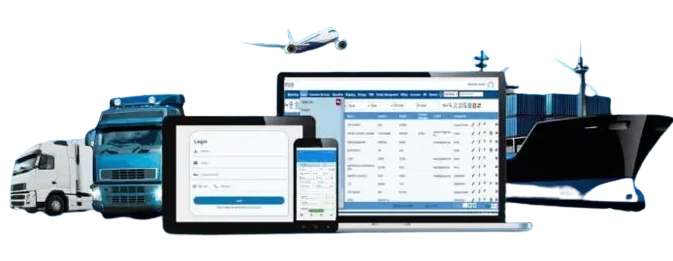
QuickMove is the single logistics solution that combines…air, sea, and road transport under one digital platform. The platform is designed for freight forwarders, movers, and transport operators willing to have full command of their operations without the need to change systems.
- Unified Job Management – Develop one job that has ocean, air, and road segments. From a single dashboard monitor each mode’s costs, margins, and documentation.
- Dynamic Workflow Templates– QuickMove changes your work processes on-the-fly. For example, Airway Bill for air, Bill of Lading for sea, CMR or LR for road are completed without the need for separate modules.
- Real-Time Visibility – Each part of the shipment is linked to one tracking interface with milestone updates,online documents, and customer visibility portals.
- Flexible Routing and Mode Conversion – You can convert a shipment from air to road or from sea to air while it is in the middle of transit, and at the same time, keep all invoices, expenses, and documents together.
- Consolidated Financials– QuickMove’s accounting engine that links mode-wise cost centers is an automatic profit-tracking system that also serves the purpose of unified invoicing for various-leg shipments.
The QuickMove Advantage
QuickMove Technologies, through AI-powered automation, integrated accounting, and fully digital workflows, has been supporting logistics businesses in 200+ countries for over 16 years. No matter whether you are in charge of containerized freight, air express, or domestic trucking, QuickMove guarantees that each movement, document, and dollar will be connected. Multi-modal logistics is not the future but the present. The companies that master it today will be the ones controlling the supply chains of tomorrow.