Email Us
 Freight Forwarding Software
 Warehouse Management System
 Transport Management System
 Moving/Removal Software
 Customer Service Portal
 Move Survey Quote Pro
 Digital Logistics Inventory App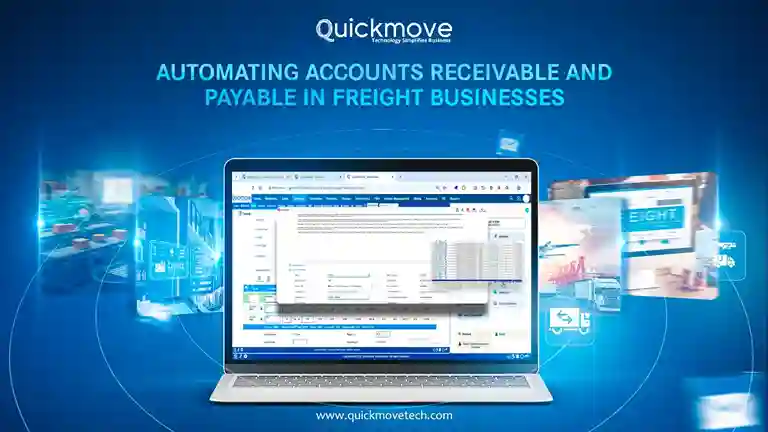
Freight forwarding is a fast-moving industry. Every day, companies coordinate shipments, negotiate rates, handle documents, manage partners, and keep cargo moving across countries and continents. Behind all this activity, however, lies a critical function that often determines whether the business runs smoothly or struggles financially — accounts receivable and accounts payable.
In simple terms:
- Accounts receivable (AR) is the money customers owe your freight business.
- Accounts payable (AP) is the money your company owes to carriers, vendors, agents, and partners.
Managing these two areas efficiently is essential for maintaining healthy cash flow and avoiding operational disruptions. Unfortunately, many freight companies still rely on manual processes, spreadsheets, and disconnected accounting tools to manage AR and AP.
This approach may work for small operations, but as shipment volumes increase, manual financial management becomes slow, error-prone, and difficult to control.
This is where automation changes everything.
Modern freight businesses are increasingly adopting freight forwarding software to automate accounts receivable and payable processes. Automation not only reduces administrative workload but also improves accuracy, speeds up payments, strengthens financial visibility, and helps businesses scale without financial chaos.
In this comprehensive guide, we will explore how automating accounts receivable and payable can transform freight operations and why technology is becoming a must-have for logistics companies.
Understanding Accounts Receivable and Payable in Freight Businesses
Before discussing automation, it is important to understand how AR and AP work in the freight forwarding environment.
Freight forwarding involves multiple financial transactions connected to each shipment.
For example, a single shipment may involve:
- Ocean or air freight charges
- Local transportation costs
- Customs clearance fees
- Warehouse charges
- Documentation fees
- Handling charges
- Agent commissions
Each of these costs must be recorded, billed, and settled properly.
Accounts Receivable (AR)
Accounts receivable includes all the invoices issued to customers for logistics services.
Typical receivable items include:
- Freight charges billed to shippers
- Handling and documentation fees
- Customs clearance charges
- Warehouse storage charges
- Last-mile delivery services
These invoices may be payable within 15, 30, or 45 days depending on credit terms.
The faster these invoices are issued and collected, the healthier the company’s cash flow becomes.
Accounts Payable (AP)
Accounts payable includes payments made to partners and vendors.
Common payable expenses include:
- Shipping line payments
- Airline charges
- Trucking and transport fees
- Customs broker charges
- Warehouse costs
- Agent commissions
Freight companies must pay these partners on time to avoid service interruptions.
Balancing receivables and payables is therefore critical for financial stability.
The Financial Complexity of Freight Businesses
Unlike many industries where transactions are straightforward, freight forwarding financial management is complex.
A single shipment might involve:
- Multiple currencies
- Multiple vendors
- Multiple documents
- Variable rates
- Additional surcharges
This complexity increases the risk of financial errors when processes are handled manually.
For instance:
- An incorrect freight rate could lead to underbilling.
- A missed vendor invoice could lead to payment disputes.
- Delayed customer billing could slow down cash flow.
When shipments number in the hundreds or thousands every month, these issues quickly become difficult to manage.
Automation helps remove these risks.
Problems with Manual Accounts Receivable and Payable Processes
Many freight companies still rely on spreadsheets, email threads, and standalone accounting tools to manage financial processes.
While this may seem manageable initially, it creates several operational problems.
1. Delayed Invoicing
Manual invoicing often depends on collecting shipment data from multiple departments.
Operations teams provide shipment details. Finance teams calculate charges. Managers approve invoices.
This process can take days or even weeks.
Delayed invoices mean delayed payments.
2. Frequent Billing Errors
Manual calculations increase the chances of mistakes such as:
- Incorrect freight rates
- Missing charges
- Currency conversion errors
- Duplicate invoices
Billing errors often lead to disputes and delayed payments.
3. Lack of Financial Visibility
Without integrated systems, financial data is scattered across different tools.
This makes it difficult to answer simple questions such as:
- Which customers owe money?
- Which vendors need to be paid?
- Which shipments are profitable?
Poor visibility leads to poor financial decisions.
4. Revenue Leakage
Revenue leakage occurs when billable services are not invoiced.
This may happen due to:
- Missing cost entries
- Communication gaps between teams
- Lost documentation
Even small billing gaps can reduce profits significantly over time.
5. Slow Payment Follow-Ups
Manual receivable tracking makes it difficult to follow up with customers.
Finance teams may only realize that invoices are overdue after several weeks.
By that time, the payment cycle becomes longer.
6. Administrative Overload
Finance teams often spend excessive time on repetitive tasks such as:
- Entering data
- Calculating invoices
- Matching payments
- Updating spreadsheets
Instead of focusing on financial analysis and strategy, teams become busy with routine work.
Why Automation Is the Future of Freight Financial Management
Automation solves many of the problems mentioned above by connecting operational and financial data in one system.
Freight forwarding software allows companies to automate billing, payments, and financial tracking across the entire shipment lifecycle.
This creates a seamless connection between operations and finance.
Automation ensures that financial processes happen faster, more accurately, and with less manual effort.
Key Benefits of Automating Accounts Receivable in Freight Businesses
Faster Invoice Generation
Automation allows invoices to be generated automatically once a shipment reaches a certain milestone.
Instead of waiting for manual calculations, the system pulls shipment details and billing data instantly.
This reduces invoicing delays significantly.
Solutions such as QuickMove Technologies’ freight forwarding software allow companies to generate invoices directly from shipment records, saving valuable time for finance teams.
Accurate Billing
Automated systems apply predefined rate structures and pricing rules.
This ensures consistent billing across shipments.
Charges such as freight rates, documentation fees, and handling charges are automatically included in invoices.
This reduces the chances of errors and disputes.
Real-Time Accounts Receivable Tracking
Automation provides clear dashboards showing:
- Outstanding invoices
- Due dates
- Payment history
- Customer credit limits
This real-time visibility helps finance teams monitor cash flow more effectively.
Automated Payment Reminders
Instead of manually sending reminder emails, automated systems can notify customers about upcoming or overdue payments.
This encourages timely payments and improves receivable collection rates.
Reduced Revenue Leakage
Automation ensures that all billable charges connected to a shipment are captured and invoiced.
This prevents missed charges and protects profit margins.
Key Benefits of Automating Accounts Payable in Freight Businesses
Automation is equally important for managing vendor payments.
Streamlined Vendor Invoice Processing
Freight companies receive invoices from multiple partners.
Automation helps record and match vendor invoices with shipment data quickly.
This reduces the risk of duplicate or incorrect payments.
Better Payment Scheduling
Automated systems allow companies to schedule vendor payments according to due dates.
This helps maintain strong relationships with carriers, agents, and service providers.
Improved Cost Control
Automated AP systems track expenses related to each shipment.
This allows businesses to understand where costs are increasing and where savings are possible.
Vendor Payment Transparency
Automation provides clear records of:
- Vendor invoices
- Payment status
- Outstanding payables
This transparency improves financial management and reduces confusion.
Connecting Operations and Finance Through Automation
One of the biggest advantages of automation is that it connects operational data with financial processes.
Shipment details, costs, and revenue information are stored in the same system.
This integration ensures that billing happens accurately and quickly.
Platforms such as QuickMove Technologies’ freight forwarding software integrate operations, accounting, and reporting into a single platform, allowing freight businesses to manage shipments and finances seamlessly.
Real-Time Financial Reporting
Automation enables businesses to generate financial reports instantly.
These reports may include:
- Profit per shipment
- Customer profitability
- Vendor expenses
- Outstanding receivables
- Payment aging reports
With accurate financial data available at any time, management can make better business decisions.
Managing Multi-Currency Transactions
Freight forwarding companies often deal with multiple currencies.
Manual currency conversions can lead to accounting mistakes.
Automation simplifies this process by automatically applying exchange rates and calculating financial values correctly.
This ensures accurate financial records and prevents profit loss due to conversion errors.
Reducing Payment Disputes
Invoice disputes often delay payments and damage business relationships.
Automation reduces disputes by creating clear, structured invoices supported by shipment records and documents.
When customers see accurate and transparent billing, they are more likely to process payments quickly.
Freight companies using QuickMove Technologies’ freight forwarder software benefit from structured billing systems that reduce confusion and improve payment transparency.
Improving Cash Flow Stability
When receivables and payables are automated, cash flow becomes more predictable.
Businesses can clearly see:
- When payments are expected
- When vendor payments are due
- How much working capital is available
This helps companies plan financial activities more effectively.
Reducing Dependency on Manual Work
Automation reduces the need for repetitive financial tasks.
Finance teams no longer need to spend hours entering data or checking calculations.
Instead, they can focus on strategic activities such as financial planning and business growth.
Strengthening Financial Compliance
Freight companies must maintain proper financial records for audits and tax compliance.
Automated systems keep detailed transaction logs, approval histories, and financial records.
This makes audits easier and ensures compliance with accounting regulations.
Systems like QuickMove Technologies’ freight forwarding software provide built-in audit trails that help companies maintain accurate financial records.
Supporting Business Growth
As freight businesses grow, the number of shipments and financial transactions increases rapidly.
Manual financial processes cannot scale easily.
Automation allows companies to manage larger shipment volumes without increasing administrative workload.
This scalability is essential for companies planning long-term growth.
Enhancing Customer Experience
Fast and accurate invoicing improves the customer experience.
Customers appreciate:
- Clear invoices
- Accurate charges
- Timely billing
Automation ensures that billing processes remain professional and efficient.
Freight businesses using QuickMove Technologies’ freight software often experience improved customer satisfaction because invoices are generated faster and with fewer errors.
Improving Vendor Relationships
Timely vendor payments are essential for maintaining strong relationships with logistics partners.
Automation helps ensure that vendors are paid on time and that payment records are well organized.
This reliability strengthens business partnerships.
Real-World Impact of Financial Automation
Companies that automate their AR and AP processes often experience measurable improvements.
Common benefits include:
- Faster invoicing
- Reduced billing errors
- Improved cash flow
- Lower administrative costs
- Better financial visibility
- Stronger customer relationships
Technology allows freight companies to manage financial operations with greater efficiency and confidence.
The Future of Financial Management in Freight Businesses
The logistics industry is becoming increasingly digital.
Customers expect faster services, and businesses must operate with greater efficiency.
Automation is no longer a luxury—it is becoming a necessity.
Freight companies that continue relying on manual financial processes may struggle to keep up with growing operational complexity.
Those that adopt automation will benefit from faster financial workflows, improved cash flow, and stronger operational control.
Conclusion
Accounts receivable and payable management is one of the most critical aspects of running a successful freight forwarding business.
Manual financial processes often lead to delays, errors, and cash flow challenges.
Automation solves these problems by connecting operational data with financial workflows.
By automating invoicing, payment tracking, and vendor management, freight companies can improve financial accuracy, reduce administrative work, and maintain stronger cash flow.
Technology platforms like QuickMove Technologies’ freight forwarding software help freight businesses manage accounts receivable and payable more efficiently by integrating financial processes with daily operations.