Email Us

 Freight Forwarding Software
 Warehouse Management System
 Transport Management System
 Moving/Removal Software
 Customer Service Portal
 Move Survey Quote Pro
 Digital Logistics Inventory App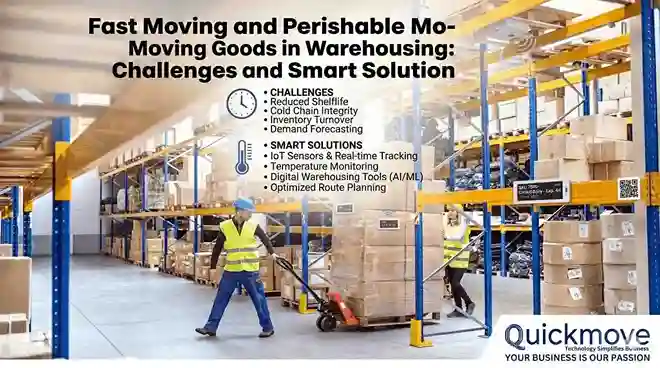
Warehousing has changed a lot over the years. What used to be a simple storage function has now become a critical part of the supply chain. And when it comes to fast moving and perishable goods, the role of a warehouse becomes even more important.
These are the products that don’t give you a second chance. If they’re delayed, mishandled, or stored incorrectly, the loss is immediate. There’s no room for guesswork.
From fresh produce and dairy to pharmaceuticals and FMCG products, businesses today are under constant pressure to move goods faster while maintaining quality. Customers expect quick delivery, regulators expect compliance, and businesses expect efficiency.
In the middle of all this, warehouses are expected to perform flawlessly.
But the reality is different.
Let’s take a closer look at the challenges warehouses face when handling fast moving and perishable goods—and more importantly, the smart solutions that can actually make a difference.
What Are Fast Moving and Perishable Goods?
Before diving into the challenges, it’s important to clearly understand what we’re dealing with.
Fast moving goods are items that are sold quickly and require frequent replenishment. These are everyday products—things people buy regularly without much thought. Examples include packaged foods, beverages, toiletries, and household items.
Perishable goods, on the other hand, are products that have a limited shelf life. They are sensitive to time and environmental conditions. This category includes fresh fruits and vegetables, dairy products, meat, medicines, and certain chemicals.
Now, when these two categories overlap—fast moving and perishable—the complexity increases significantly.
You’re not just managing inventory.
You’re managing time, condition, and movement—all at once.
Why These Goods Are So Challenging to Handle
At first glance, moving goods quickly might sound like a good thing. High turnover means high demand, right?
But in warehousing, speed without control can quickly turn into chaos.
Here’s why fast moving and perishable goods are particularly difficult to manage:
- They require constant monitoring
- They involve tight timelines
- They leave very little margin for error
- They demand accurate coordination between teams
A small delay in dispatch or a minor mistake in stock rotation can lead to expired goods, customer complaints, or financial loss.
And unlike durable goods, you can’t just “fix it later.”
The Real Challenges Warehouses Face
Let’s break down the most common and practical challenges warehouses deal with every day.
1. Limited Shelf Life and Expiry Management
This is the most obvious challenge—and also the most critical one.
Perishable goods come with expiration dates. Some products last for months, while others may only be usable for a few days.
If these items are not tracked properly, warehouses risk:
- Shipping expired products
- Holding onto stock that can’t be sold
- Losing large amounts of inventory
Many warehouses still rely on manual checks or basic systems that don’t actively track expiry dates. This makes it easy for products to slip through the cracks.
2. High Inventory Turnover
Fast moving goods don’t stay in the warehouse for long. They come in, get stored briefly, and are dispatched almost immediately.
This constant movement creates operational pressure:
- Frequent inbound shipments
- Continuous picking and packing
- High volume of orders
Without a structured system, it becomes difficult to keep track of what’s coming in and going out at any given moment.
3. Stock Rotation Issues (FIFO and FEFO)
Stock rotation is one of the most important practices in managing perishable goods.
- FIFO (First In, First Out) ensures older stock is used first
- FEFO (First Expiry, First Out) ensures items with the nearest expiry are prioritized
But in real-world warehouse conditions, these methods are often not followed consistently.
Why?
Because manual tracking makes it difficult to:
- Identify which batch came first
- Track expiry dates accurately
- Ensure pickers select the correct items
As a result, newer stock may get shipped while older stock sits unused—leading to waste.
4. Lack of Real-Time Visibility
One of the biggest problems in traditional warehousing is the lack of visibility.
Warehouse managers often don’t have real-time answers to questions like:
- Which items are about to expire?
- What is the current stock level?
- Where exactly is a product located?
- Which products are moving the fastest?
Without this visibility, decision-making becomes reactive instead of proactive.
5. Storage Condition Sensitivity
Many perishable goods require specific storage conditions.
For example:
- Dairy products need refrigeration
- Medicines may require controlled environments
- Fresh produce may need humidity control
Even slight deviations in temperature or handling can affect product quality.
Managing these conditions manually across a large warehouse is extremely difficult.
6. Human Errors and Manual Processes
Despite advancements in technology, many warehouses still depend heavily on manual processes.
This leads to:
- Incorrect data entry
- Misplaced inventory
- Picking errors
- Delayed updates
When dealing with perishable goods, even a small mistake can have serious consequences.
7. Demand Fluctuations and Planning Issues
Fast moving goods often experience unpredictable demand.
A product that sells quickly today may slow down tomorrow—and vice versa.
Without accurate data and forecasting, warehouses may:
- Overstock certain items
- Understock high-demand products
- Struggle to balance inventory
This directly impacts both efficiency and profitability.
Why Traditional Systems Are No Longer Enough
Many warehouses still use spreadsheets or basic software to manage operations.
While these methods may work for smaller setups, they fall short in complex environments.
Here’s why:
- They don’t update in real time
- They rely heavily on manual input
- They lack automation
- They don’t provide actionable insights
In short, they cannot keep up with the speed and complexity of modern warehousing.
Smart Solutions That Actually Work
The good news is that these challenges can be solved—with the right approach.
Let’s look at practical, proven solutions that warehouses can implement.
1. Real-Time Inventory Tracking
Having real-time visibility into inventory is a game changer.
It allows warehouse teams to:
- Monitor stock levels instantly
- Track movement of goods
- Identify issues before they escalate
Instead of reacting to problems, teams can act proactively.
2. Automated Expiry Tracking
A smart system should automatically track expiry dates and alert users when products are nearing their end of life.
This helps in:
- Prioritizing dispatch
- Planning promotions or discounts
- Reducing wastage
3. Intelligent Stock Rotation
Automation ensures that FIFO and FEFO are followed consistently.
The system can guide pickers to select the right items, removing guesswork and reducing errors.
4. Categorization of Fast-Moving Goods
Identifying fast-moving products allows warehouses to optimize storage.
These items can be placed in easily accessible locations, improving picking speed and efficiency.
5. Process Standardization
Every step—from receiving goods to dispatching them—should follow a clear, standardized process.
This reduces confusion and ensures consistency across operations.
6. Data-Driven Decision Making
Modern systems provide insights into:
- Product movement trends
- Demand patterns
- Inventory performance
This helps businesses make better decisions and plan more effectively.
How Modern WMS Solutions Make a Difference
This is where a robust warehouse management system becomes essential.
A well-designed system doesn’t just store data—it actively helps manage operations.
For example, QuickMove’s warehouse management system is built to handle the challenges associated with fast moving and perishable goods.
It enables real-time tracking of inventory, ensuring that warehouse teams always have accurate and up-to-date information. This level of visibility helps prevent errors and improves overall efficiency.
The system also supports better stock rotation practices, making it easier to prioritize items based on their expiry dates. This reduces the chances of expired goods sitting in storage.
Real-World Impact: What Changes After Implementation
When warehouses move from manual processes to a structured system, the difference is noticeable.
1. Reduced Product Loss
Better tracking and rotation mean fewer expired or wasted products.
2. Faster Operations
Optimized workflows and better organization lead to quicker picking and dispatch.
3. Improved Accuracy
Automation reduces human errors and ensures data consistency.
4. Better Customer Satisfaction
Timely deliveries and high-quality products improve customer trust.
A Practical Example
Consider a mid-sized food distribution company handling dairy and packaged goods.
Before implementing a proper system:
- They struggled with expired inventory
- Dispatch delays were common
- Inventory data was often inaccurate
After adopting a structured approach supported by a solution like QuickMove’s warehouse management system, they were able to:
- Track expiry dates more effectively
- Improve stock rotation
- Reduce wastage significantly
- Speed up order fulfillment
This is not an isolated case—it’s a common outcome when the right systems are in place.
Steps to Improve Your Warehouse Operations
If you’re dealing with fast moving and perishable goods, here’s a simple roadmap:
Step 1: Evaluate Your Current System
Identify gaps in visibility, tracking, and processes.
Step 2: Implement Better Tracking
Move away from manual methods and adopt real-time systems.
Step 3: Focus on Stock Rotation
Ensure FIFO or FEFO is followed consistently.
Step 4: Automate Where Possible
Reduce reliance on manual processes.
Step 5: Use Data for Decision Making
Analyze trends and optimize operations accordingly.
Many businesses are already taking these steps with solutions like QuickMove’s warehouse management system, which helps simplify complex warehouse operations without adding unnecessary complications.
The Future of Warehousing for Perishable Goods
As supply chains become faster and more customer-driven, the expectations from warehouses will continue to grow.
We can expect:
- Greater use of automation
- Increased reliance on real-time data
- More focus on efficiency and sustainability
Warehouses that adapt to these changes will be better positioned to succeed.
Conclusion
Managing fast moving and perishable goods is one of the toughest challenges in warehousing. It requires precision, speed, and constant attention.
While the risks are high, the solutions are clear.
By adopting smarter processes and leveraging modern technology, warehouses can reduce losses, improve efficiency, and deliver better results.
A system like QuickMove’s warehouse management system can support this transformation by bringing structure, visibility, and control into daily operations.
In a fast-paced supply chain environment, that kind of control is not just helpful—it’s essential.