Email Us

 Freight Forwarding Software
 Warehouse Management System
 Transport Management System
 Moving/Removal Software
 Customer Service Portal
 Move Survey Quote Pro
 Digital Logistics Inventory App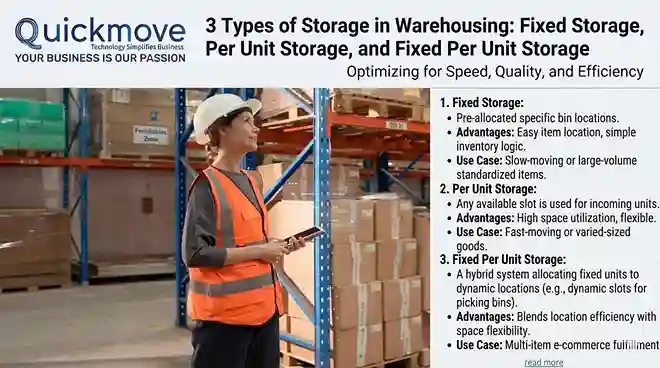
When people think about warehousing, they usually imagine racks, boxes, and forklifts moving goods around. But behind all of that physical movement, there’s a system that determines how space is used, how costs are calculated, and how efficiently operations run.
One of the most important—and often overlooked—parts of warehouse management is how storage is structured and priced.
If you’re running a warehouse, especially in logistics, relocation, or 3PL services, the way you define storage types can directly affect your profitability, operational clarity, and customer satisfaction.
In this blog, we’ll break down three common types of storage used in warehouses:
- Fixed Storage (HHG – Household Goods)
- Per Unit Storage
- Fixed Per Unit Storage
Why Storage Type Matters More Than You Think
Before jumping into the types, let’s understand why this topic is important.
Storage isn’t just about “keeping goods somewhere.” It affects:
- How you charge customers
- How you allocate space
- How you track inventory
- How efficiently your warehouse runs
If your storage model is unclear or inconsistent, you may face:
- Revenue leakage
- Billing disputes
- Space mismanagement
- Operational confusion
That’s why choosing the right storage type—and managing it properly—is critical.
1. Fixed Storage (HHG – Household Goods)
What is Fixed Storage (HHG)?
Let’s start with one of the most commonly used storage models in relocation and moving industries.
Fixed storage, often used for Household Goods (HHG), means you allocate a fixed amount of space to a customer—regardless of how much they actually use.
For example:
- A customer is assigned a storage unit or container
- They are charged a fixed monthly fee
- The cost does not change based on the volume inside
Think of it like renting a storage room. Whether you fill it completely or only use half of it, the price remains the same.
Where is Fixed Storage Used?
This model is commonly used in:
- Household goods storage
- Moving and relocation companies
- Long-term storage contracts
- Personal storage services
Advantages of Fixed Storage
1. Simple Pricing
Customers know exactly what they’ll pay every month. No surprises.
2. Easy to Manage
Warehouse teams don’t need to calculate volume or track unit-level storage continuously.
3. Predictable Revenue
For businesses, fixed pricing ensures steady income.
Challenges of Fixed Storage
1. Space Inefficiency
If a customer uses only part of the allocated space, the rest remains unused.
2. Limited Flexibility
Not ideal for businesses with fluctuating inventory levels.
3. Potential Overpricing or Underpricing
Some customers may feel they are overpaying, while others may be getting more value than they should.
How Technology Helps
Managing fixed storage becomes much easier with a structured system.
A platform like QuickMove’s warehouse management system allows you to:
- Allocate storage spaces clearly
- Track occupancy
- Manage contracts efficiently
- Avoid confusion in billing
Instead of relying on manual records, everything is centralized and transparent.
2. Per Unit Storage
Now let’s move to a more flexible and usage-based model.
What is Per Unit Storage?
Per unit storage means customers are charged based on the number of units they store.
A “unit” could be:
- A box
- A pallet
- A container
- Any defined measurable item
For example:
- ₹X per pallet per month
- ₹Y per box per week
The total cost depends on how many units are stored.
Where is Per Unit Storage Used?
This model is widely used in:
- 3PL warehouses
- E-commerce fulfillment centers
- FMCG storage
- Short-term storage services
Advantages of Per Unit Storage
1. Fair Pricing
Customers pay only for what they use.
2. High Flexibility
Ideal for businesses with changing inventory levels.
3. Better Space Utilization
Warehouse space is used more efficiently.
Challenges of Per Unit Storage
1. Complex Tracking
Every unit must be tracked accurately.
2. Billing Complexity
Calculations can become complicated, especially with fluctuating inventory.
3. Higher Dependency on Systems
Manual tracking is almost impossible at scale.
The Role of Automation
This is where modern systems become essential.
With QuickMove’s warehouse management system, you can:
- Track each unit in real time
- Automatically calculate storage costs
- Generate accurate billing reports
- Monitor inventory movement without manual effort
This reduces errors and ensures transparency for both the warehouse and the customer.
3. Fixed Per Unit Storage
This model combines elements of both fixed and per unit storage.
What is Fixed Per Unit Storage?
In this model:
- A fixed rate is assigned per unit
- Customers are charged based on the number of units
- But the rate remains constant over time
For example:
- ₹100 per pallet per month (fixed rate)
- If a customer stores 10 pallets → ₹1000/month
The rate doesn’t change, but the total cost depends on quantity.
Where is Fixed Per Unit Storage Used?
This model is useful in:
- Contract-based warehousing
- Long-term business clients
- B2B logistics services
Advantages of Fixed Per Unit Storage
1. Balance Between Flexibility and Stability
Customers pay based on usage, but pricing remains predictable.
2. Easier Forecasting
Both the warehouse and the client can estimate costs easily.
3. Scalable Model
Works well as businesses grow.
Challenges of Fixed Per Unit Storage
1. Requires Accurate Unit Definition
Units must be standardized.
2. Needs Strong Tracking System
Without proper tracking, billing errors can occur.
How Systems Simplify This Model
Using QuickMove’s warehouse management system, businesses can:
- Define unit structures clearly
- Apply fixed rates automatically
- Track usage in real time
- Generate invoices without manual calculations
This ensures consistency and reduces disputes.
Choosing the Right Storage Model
There’s no one-size-fits-all answer.
Here’s a simple way to decide:
Choose Fixed Storage if:
- You deal with household goods
- You want simple pricing
- You offer long-term storage
Choose Per Unit Storage if:
- You manage dynamic inventory
- You work with multiple clients
- You need flexibility
Choose Fixed Per Unit Storage if:
- You want predictable pricing
- You handle B2B clients
- You need scalability
Why Many Warehouses Struggle with Storage Models
Even after choosing the right model, execution becomes the real challenge.
Common problems include:
- Inaccurate tracking
- Manual billing errors
- Lack of visibility
- Miscommunication with clients
This is not because the model is wrong—but because the system supporting it is weak.
How a Modern WMS Solves These Problems
A warehouse management system is not just a tool—it’s the backbone of your operations.
With QuickMove’s warehouse management system, warehouses can:
- Manage multiple storage types in one platform
- Track inventory in real time
- Automate billing processes
- Reduce human errors
Instead of juggling spreadsheets and manual logs, everything becomes streamlined.
Real-World Scenario
Let’s say a logistics company handles:
- Household goods (fixed storage)
- FMCG products (per unit storage)
- Corporate clients (fixed per unit storage)
Without a proper system, managing all three would be chaotic.
But with QuickMove’s warehouse management system, they can:
- Assign different storage models to different clients
- Track everything in one place
- Generate accurate invoices
- Improve operational efficiency
The Business Impact of Getting Storage Right
When storage models are implemented correctly, the results are clear:
- Better revenue control
- Improved customer trust
- Reduced operational confusion
- Higher efficiency
On the other hand, poor storage management leads to:
- Losses
- Disputes
- Inefficiency
Future of Storage in Warehousing
As warehousing becomes more advanced, we’ll see:
- More dynamic pricing models
- Increased automation
- Better data-driven decisions
Systems like QuickMove’s warehouse management system are already helping businesses move in this direction by making storage management more intelligent and scalable.
Practical Tips to Improve Your Storage Management
If you want to improve your current setup, start with these steps:
1. Define Your Storage Types Clearly
Avoid mixing models without structure.
2. Standardize Units
Ensure consistency across operations.
3. Automate Tracking
Move away from manual processes.
4. Use Data for Decisions
Analyze usage patterns and optimize space.
5. Invest in the Right System
A strong system like QuickMove’s warehouse management system can simplify everything from tracking to billing.
Conclusion
Storage is not just about space—it’s about strategy.
Whether you use fixed storage, per unit storage, or fixed per unit storage, the goal is the same:
efficient operations, accurate billing, and better customer experience.
Each model has its strengths and challenges, but the real difference comes from how well you manage it.
With the right processes and tools in place, warehouses can turn storage from a basic function into a competitive advantage.
And with solutions like QuickMove’s warehouse management system, managing multiple storage types becomes not just possible—but simple, scalable, and efficient.