Email Us
 Freight Forwarding Software
 Warehouse Management System
 Transport Management System
 Moving/Removal Software
 Customer Service Portal
 Move Survey Quote Pro
 Digital Logistics Inventory App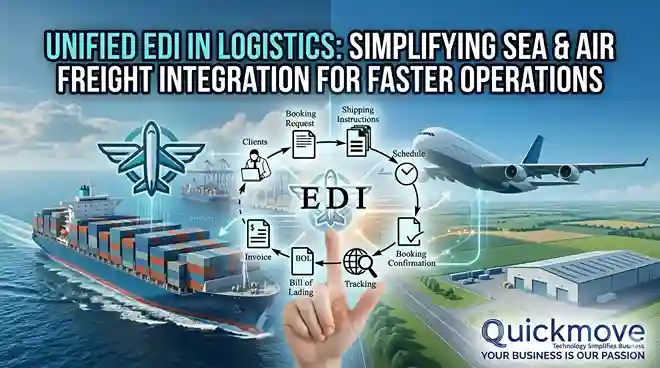
Logistics may become complicated rapidly, especially when dealing with various types of shipping such as sea freight and air freight. Each has its own data formats, systems, and regulations.
For many firms, this leads to confusion, delays, and additional manual work.
However, what if you could handle everything in a straightforward, cohesive manner?
This is where Unified EDI (Electronic Data Interchange) helps to streamline, expedite, and simplify logistical processes.
The real question is What is EDI?
Electronic Data Interchange (EDI) lets businesses exchange documents digitally instead of using paper or emails.
For example:
- Shipping instructions
- Information on the bill
- Delivery updates
Instead of sending files by hand, systems communicate with each other automatically.
This reduces mistakes and saves time.
Different Air and Sea Freight Systems
This is when things become complicated.
- The IFTMCS format is used for sea freight.
- FWB and FHL are formats used for air freight.
Consider it this way:
It’s similar like doing the same work in two distinct languages.
If both are not adequately handled by your system:
• Manual conversions could be required.
• Mistakes may occur.
• Delays in shipments
Your entire operation is slowed down as a result.
This is the Solution a Single System That Handles Everything
QuickMove and other contemporary logistics platforms use a unified internal data model to address this issue.
Although it sounds complicated, it’s actually very easy.
In simple terms, this is how it operates:
- You input shipment information only once.
- The system recognizes if the cargo is being transported by air or water.
The data is automatically transformed into the appropriate format:
Sea → IFTMCS
Air → FWB/FHL
Why This Will Change Everything for Your Company
1. Time-saving
Data conversion by hand is over. It is all automatic.
2. Lessens Mistakes
Errors are reduced with less human participation.
3. Quicker Delivery
Documents are processed and transmitted immediately.
4. Simple to Expand
The system continues to function flawlessly whether you manage 10,000 shipments or just 10.
5. Reduced Prices
Reduced operational costs and less manual labor. Simple Integration with International Shipping Platforms.
To be competitive, today’s logistics companies must integrate with international systems.
JSON-based integration, which is merely a contemporary and adaptable method of system communication, is supported by QuickMove.
It links to important platforms such as ADDITIONAL CargoSmart
What does this mean for you?
- You can send Shipping Instructions directly to carriers
- No need for emails or manual uploads
- Faster communication
- Real-time updates
Everything becomes faster, smoother, and more reliable.
Real-Life Example (Simple Scenario)
Imagine you run a logistics company.
- You handle both air and sea shipments
- Earlier, your team had to:
- Manually prepare different documents
- Convert formats
- Double-check for errors
Now with a unified system:
- You enter details once
- The system does everything automatically
- Documents are sent instantly
Result: Faster operations happier customers
Why This Matters for Business Owners & Managers
If you’re a:
- Logistics manager
- Freight forwarder
- Supply chain head
- Business owner
This directly impacts your:
Customer Satisfaction
Faster deliveries and fewer errors build trust.
Team Productivity
Your team spends less time on repetitive tasks.
Business Growth
You can handle more shipments without increasing workload.
Conclusion
Managing both sea and air freight doesn’t have to be complicated anymore. A unified EDI system simplifies operations by handling different formats like IFTMCS, FWB, and FHL automatically so your team can focus on moving shipments faster instead of managing data.
By reducing manual work and errors, businesses can improve efficiency, speed, and overall accuracy. This leads to smoother workflows, better communication, and faster delivery processes.
With integrations through platforms like INTTRA and CargoSmart, your logistics operations become more connected and scalable, allowing real-time data exchange with global carriers.
In simple terms, a unified EDI approach helps you save time, reduce complexity, and grow your logistics business with confidence making your operations ready for the future.