Email Us

 Freight Forwarding Software
 Warehouse Management System
 Transport Management System
 Moving/Removal Software
 Service Portal
 Move Survey Quote Pro
 Digital Logistics Inventory App
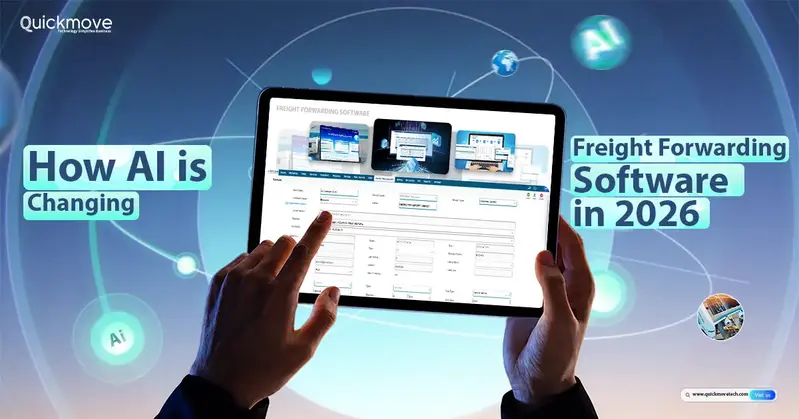
Freight forwarding teams devote significant time to transcribing cargo details, reviewing supplier invoices, and looking for updates. Repeated entry of the same data via sales, operations, and accounts can impede decision-making and lead to preventable mistakes.
Businesses are using AI for freight forwarding software in 2026 to transform documents and inquiries into operational data that can be used. The prospect is realistic for businesses in the Gulf Cooperation Council (GCC): respond to clients more quickly, cut down on administrative tasks, and provide staff with more precise information for handling shipments.
What AI Adds to Digital Freight Software
Digital freight software offers a unified system for managing inquiries, bookings, paperwork, shipment updates, and billing. AI enhances skills like document interpretation, incoming request organization, and outcome estimation based on available data.
When selecting a platform, this distinction is important. A set rule may be followed by an automated reminder. AI may be used to analyze an email inquiry or read various invoice layouts. Companies should assess how well a feature works and how accurate its output is.
How AI Is Improving Everyday Freight Operations
Faster Document Processing and Job Creation
A shipment may include a bill of lading, an air waybill, supplier invoices, and supporting documentation. It takes more work to enter each person’s information before the cargo can be handled.
Information can be extracted and added to pertinent records using AI document readers. Vendor invoice extraction and job creation from house and master bills of lading are covered in QuickMove’s April 2026 AI Reader version.
For a freight manager, the useful improvement is a shorter path from document receipt to work preparation. Before approving the record, staff should verify any ambiguous fields, including shipping references, quantities, currencies, and charges.
Quicker Enquiry Handling and Quotation Preparation
Freight requests are frequently sent by customers as emails with papers attached. Those requests can be transformed into structured quotation inputs with the use of freight AI software. AI extraction of request-for-quotation data and creation of structured quote data are described in DHL’s May 2026 investor presentation.
A helpful inquiry procedure, for instance, would note the origin, destination, cargo weight, and requested service before highlighting the information that the customer still has to provide. The sales staff can concentrate on finishing the inquiry and reviewing the business offer.
Valid carrier rates, relevant fees, and authorized margins should all be used in the final price. AI support does not eliminate the requirement to validate these inputs.
Earlier Visibility of Shipment Problems
AI cargo software can support predictive visibility when it has access to suitable shipment data. DP World’s purchase order management offering, supported by Infor Nexus, describes AI insights, predicted arrival times, and exception alerts.
For a forwarder, an earlier warning can support decisions about delivery arrangements, customer communication or alternative transport. A useful alert should explain which shipment needs attention and the information behind the warning.
Predictions depend on data quality and coverage. Ask the provider which carriers, routes, and transport modes it supports, how often information is refreshed and how staff can distinguish estimated events from confirmed updates.
More Timely Cost Review
AI can also help bring invoice information into financial workflows sooner. QuickMove describes extracting vendor details, invoice numbers, and charges from uploaded PDFs, alongside AI-assisted costing based on shipment and service information.
The commercial value comes from connecting those inputs with the job’s cost records. Accounts and operations can then review differences between expected and recorded charges.
Consider an illustrative shipment with customer revenue of AED 12,000 and estimated direct costs of AED 10,000. Its expected gross profit is AED 2,000. If an additional AED 700 cost is absorbed without changing revenue, gross profit falls to AED 1,300. Recording the extra charge promptly gives the team a more current view of the shipment’s margin.
Digital Cargo Software for the GCC Market
For businesses serving Saudi Arabia, the UAE, Qatar, Kuwait, Bahrain and Oman, software selection should reflect the countries, customers and transport services involved.
There are already practical regional examples of AI in shipping. In May 2026, DHL Express introduced photo-based item identification in several markets, including the UAE. Customers could review and edit the suggested item description before submitting it. This express-shipping example illustrates how AI can assist information capture while keeping the user involved.
When evaluating digital cargo software for the GCC market, assess:
- Currency handling, including supplier charges, customer invoices, and exchange-rate records.
- Arabic and English document support where required, tested with actual business documents.
- Country-specific invoice formats, tax configuration, and any required electronic invoicing or customs integrations.
- Shared shipment records for branches, overseas agents and internal teams, with appropriate access controls.
- Support for air, sea and road workflows that your company actually operates.
The right freight forwarding software for the GCC countries should demonstrate these requirements through representative jobs. Confirm the scope of each local integration during the demonstration.
Why Connected Data Matters in 2026
AI features depend on the information available to them. If shipment references, charges, or status updates are incomplete, the resulting recommendations may also be incomplete.
Industry data standards are therefore relevant to software selection. IATA confirmed that ONE Record became its preferred method for air cargo data exchange from January 2026. Its purpose is to support connected cargo information across industry participants.
For buyers, this reinforces the importance of asking how cargo software exchanges information with carriers, partners, and existing business systems.
How QuickMove Supports Freight Forwarding Businesses
QuickMove Technologies brings freight operations and business management into an integrated platform. Its freight forwarding software supports air, sea and road operations, shipment tracking, documentation, billing, and shipment-level profitability analysis.QuickMove’s published AI offering includes vendor invoice creation from uploaded documents, automatic job creation from supported transport documents, and smart costing. Together, these capabilities address practical administrative tasks around shipment preparation and financial records.
For a GCC freight business, a useful demonstration should follow a representative enquiry through job creation, document handling, and billing. Use sample documents from your own operations to confirm extraction quality, regional requirements, and the features included in the proposed setup.
How to Assess the Business Value of AI
Start with one process that creates regular delays, such as invoice entry or enquiry preparation. Record its current performance, run a pilot, and compare the results.
Useful measures include:
- Time taken to prepare an enquiry or shipment record.
- Number of extracted fields that require correction.
- Time between receiving a supplier invoice and recording its cost.
- Time taken to respond to a shipment exception.
Include subscription, integration, training, and review effort in the evaluation. This gives decision makers a clearer basis for choosing AI capabilities that fit the business.
How should GCC companies choose freight forwarding software?
Test the platform against your transport modes, document formats, currencies, branch structure, and local requirements. Ask the provider to demonstrate the complete workflow using representative shipment data.