Email Us
 Freight Forwarding Software
 Warehouse Management System
 Transport Management System
 Moving/Removal Software
 Customer Service Portal
 Move Survey Quote Pro
 Digital Logistics Inventory App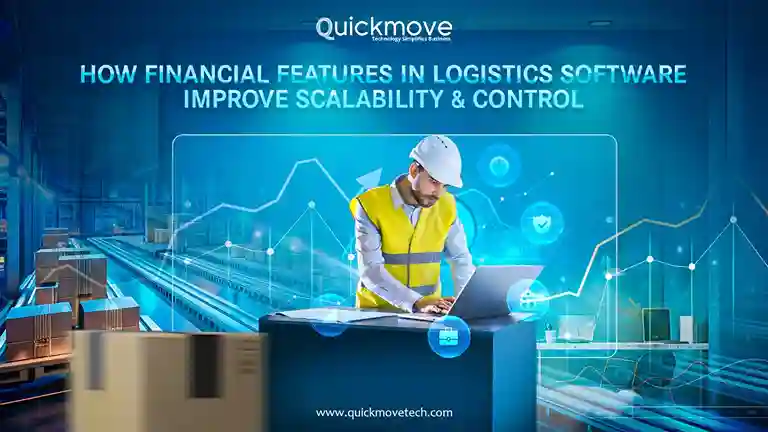
Logistics businesses don’t fail because they lack demand. They struggle because they lose control over costs, cash flow, and operational visibility as they grow.
At the early stage, managing finances with spreadsheets or basic accounting tools may seem enough. But as operations expand—more shipments, vendors, warehouses, and routes—the financial side becomes complex. Small inefficiencies turn into major losses. Payments get delayed. Costs go unnoticed. Margins shrink quietly.
This is where financial planning, monitoring, and control features in logistics software make a real difference.
This blog will break down how these features help logistics businesses scale sustainably while maintaining strong control over operations.
Why Financial Control is the Backbone of Logistics Growth
Before we get into software features, let’s understand the core problem.
Logistics is a cost-heavy business. Every movement involves:
- Fuel expenses
- Driver wages
- Toll charges
- Maintenance costs
- Vendor payments
- Warehouse handling charges
Now imagine managing all of this manually across hundreds or thousands of shipments.
What usually happens?
- Costs are recorded late
- Invoices don’t match actual services
- Vendor payments go unchecked
- Profitability is unclear per shipment
- Cash flow becomes unpredictable
As a result, businesses grow in revenue but not in profit.
Financial planning and control features in logistics software solve this by bringing structure, automation, and visibility into every financial activity.
The Three Pillars: Planning, Monitoring, and Control
To truly scale, logistics companies need to master three financial pillars:
1. Financial Planning
This is about forecasting costs, budgeting, and setting expectations before operations begin.
2. Financial Monitoring
This involves tracking real-time expenses, revenues, and financial performance.
3. Financial Control
This ensures that actual operations stay aligned with planned budgets and financial goals.
Modern logistics software like QuickMove integrates all three seamlessly.
Financial Planning: Building a Predictable Logistics Operation
Scaling without planning is like driving without a map. You might move fast, but you won’t know where you’re headed—or when you’ll crash.
Key Financial Planning Features in Logistics Software
Budgeting for Operations
Good logistics software allows you to define budgets for:
- Trips
- Routes
- Projects
- Warehouses
- Clients
Instead of guessing costs, you can plan them in advance.
Example:
If a route from Bangalore to Mumbai usually costs ₹45,000, you can set this as a benchmark. Any deviation later becomes visible.
Cost Estimation Before Execution
Before confirming a shipment, the system can estimate:
- Transportation cost
- Handling charges
- Labor costs
- Additional expenses
This helps in quoting accurate prices to customers.
Why this matters:
Underquoting kills margins. Overquoting loses clients. Accurate estimation keeps you competitive and profitable.
Financial Forecasting
Advanced systems analyze past data to predict:
- Monthly expenses
- Revenue trends
- Seasonal cost fluctuations
This helps in making smarter decisions like:
- When to expand fleet
- When to hire staff
- When to optimize routes
Scenario Planning
What if fuel prices increase by 10%?
What if demand spikes during festive seasons?
With planning tools, you can simulate these scenarios and prepare in advance.
How This Improves Scalability
When financial planning is strong:
- You avoid unexpected losses
- You price services correctly
- You allocate resources efficiently
- You expand with confidence
Scaling becomes structured—not chaotic.
2. Financial Monitoring: Real-Time Visibility into Every Rupee
Planning is important, but without monitoring, it’s useless.
You need to know what’s happening right now—not after the damage is done.
Key Monitoring Features in Logistics Software
Real-Time Expense Tracking
Every expense can be logged instantly:
- Fuel entries
- Driver allowances
- Vendor charges
- Maintenance costs
This creates a live financial picture of your operations.
Trip-Level Profitability Tracking
Instead of waiting for monthly reports, you can see:
- Revenue per trip
- Cost per trip
- Profit or loss instantly
Example:
A shipment may look profitable overall, but if one route consistently loses money, you can identify and fix it quickly.
Vendor Cost Monitoring
Logistics businesses work with multiple vendors:
- Transporters
- Packers
- Warehouse providers
Software tracks:
- Vendor-wise expenses
- Rate consistency
- Overbilling issues
Accounts Receivable & Payable Tracking
You can monitor:
- Pending customer payments
- Overdue invoices
- Upcoming vendor payments
This improves cash flow management significantly.
Dashboards & Reports
Modern systems provide simple dashboards showing:
- Daily expenses
- Revenue trends
- Profit margins
- Outstanding payments
No need to dig through spreadsheets.
How This Improves Business Control
With real-time monitoring:
- You catch issues early
- You avoid financial leaks
- You make faster decisions
- You improve accountability across teams
Instead of reacting late, you stay in control.
3. Financial Control: Keeping Everything in Check
Planning and monitoring are powerful—but control is what enforces discipline.
This is where many logistics businesses fail.
Key Financial Control Features
Approval Workflows
Expenses and invoices can require approvals before being finalized.
Example:
- Fuel expenses above ₹10,000 need manager approval
- Vendor invoices must match agreed rates
This prevents unauthorized spending.
Budget vs Actual Comparison
The system automatically compares:
- Planned costs vs actual costs
- Expected revenue vs actual revenue
Any deviation becomes visible immediately.
Automated Invoice Validation
Invoices can be cross-checked with:
- Work orders
- Contracts
- Actual services delivered
This reduces billing errors and fraud.
Cost Allocation & Tracking
Costs can be assigned to:
- Specific clients
- Projects
- Departments
This helps in understanding true profitability.
Audit Trails
Every financial action is recorded:
- Who created an entry
- Who approved it
- When it was modified
This ensures transparency and accountability.
How This Strengthens Business Control
Strong control systems:
- Reduce financial errors
- Prevent misuse of funds
- Ensure compliance
- Build trust with clients and partners
As your business grows, control becomes even more critical.
The Real Impact: Connecting Finance with Operations
One of the biggest advantages of logistics software is integration.
Financial features are not isolated—they are connected with operations.
Example Workflow
- A shipment is created
- Cost is estimated automatically
- Budget is assigned
- Expenses are tracked in real time
- Invoice is generated
- Profitability is calculated instantly
Everything is connected.
This eliminates:
- Duplicate data entry
- Manual errors
- Delayed reporting
Common Challenges Without Financial Features
Let’s look at what happens without proper financial systems:
1. Revenue Growth Without Profit Growth
You may handle more shipments, but margins shrink due to uncontrolled costs.
2. Cash Flow Problems
Delayed payments and poor tracking lead to liquidity issues.
3. Lack of Visibility
You don’t know which routes, clients, or services are profitable.
4. Operational Inefficiencies
Decisions are based on assumptions, not data.
5. Increased Risk of Errors and Fraud
Manual processes increase the chances of mistakes and misuse.
How QuickMove’s Logistics Software Helps
QuickMove’s logistics software is designed to solve these exact challenges by combining financial planning, monitoring, and control into one unified system.
What Makes It Different?
1. End-to-End Financial Visibility
From the moment a job is created to the final payment, everything is tracked.
2. AI-Powered Cost Insights
The system learns from past data to improve cost estimation and forecasting.
3. Automated Financial Workflows
Invoices, approvals, and reports are automated—reducing manual work.
4. Real-Time Profitability Tracking
Know your margins instantly, not after the month ends.
5. Seamless Integration with Operations
Finance is not separate—it’s built into every logistics activity.
Real-Life Scenario: Scaling Without Losing Control
Let’s say a logistics company starts with:
- 20 shipments per day
- 5 vendors
- 2 warehouses
Manual systems may work at this stage.
Now fast forward:
- 200 shipments per day
- 50 vendors
- 10 warehouses
Without proper financial systems:
- Tracking costs becomes impossible
- Vendor payments become chaotic
- Profitability becomes unclear
With logistics software:
- Everything remains structured
- Financial visibility stays intact
- Growth becomes manageable
Key Benefits for Logistics Businesses
1. Better Profit Margins
Accurate costing and monitoring reduce unnecessary expenses.
2. Improved Cash Flow
Faster invoicing and payment tracking ensure steady cash movement.
3. Faster Decision-Making
Real-time data allows quicker and smarter decisions.
4. Stronger Vendor Management
You know exactly how much you’re paying and why.
5. Scalable Operations
Systems grow with your business without losing control.
Best Practices for Using Financial Features Effectively
Having software is not enough—you need to use it properly.
1. Define Clear Budgets
Set realistic budgets for every operation.
2. Track Expenses Consistently
Ensure all costs are recorded in real time.
3. Use Reports Regularly
Don’t wait for problems—review data frequently.
4. Set Approval Rules
Control spending with proper authorization workflows.
5. Train Your Team
Make sure everyone understands how to use the system.
The Future: Smarter Financial Management in Logistics
Financial management in logistics is evolving rapidly.
Trends to Watch
- AI-driven financial forecasting
- Predictive cost optimization
- Automated compliance checks
- Real-time financial dashboards
Businesses that adopt these technologies early will have a strong competitive advantage.
Final Thoughts
Scaling a logistics business is not just about moving more goods—it’s about managing money smarter.
Without financial planning, monitoring, and control, growth becomes risky.
With the right logistics software:
- You gain visibility
- You reduce risks
- You improve profitability
- You scale with confidence
QuickMove’s logistics software brings all these capabilities together, helping businesses grow without losing control.