Email Us
 Freight Forwarding Software
 Warehouse Management System
 Transport Management System
 Moving/Removal Software
 Customer Service Portal
 Move Survey Quote Pro
 Digital Logistics Inventory App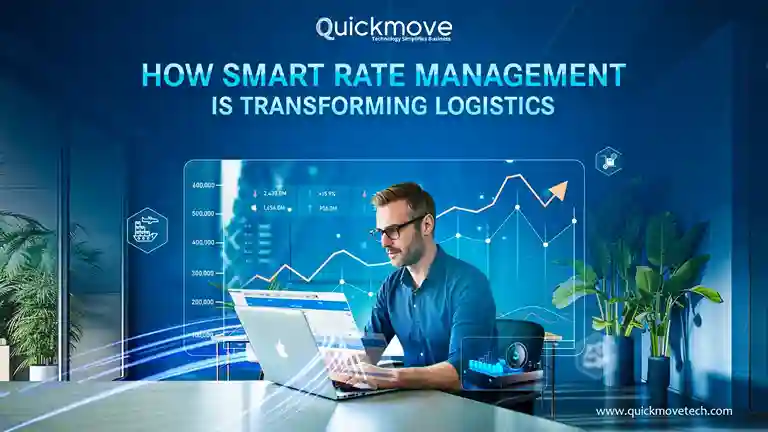
In logistics, pricing is everything—but it’s also one of the most complicated parts of the business.
If you’ve ever worked in freight forwarding, shipping, or supply chain operations, you already know how chaotic rate management can get. One moment you’re comparing carrier quotes, the next you’re digging through spreadsheets, emails, or past bookings just to figure out what price makes sense. And by the time you finalize a quote, the rates may have already changed.
This is exactly the problem modern logistics software is trying to solve.
In this blog, we’ll take a deep dive into how rate management works today, why it’s so fragmented, and how platforms like QuickMove are building smarter systems to simplify and optimize it. We’ll also explore how their evolving Rate Engine and AI-driven optimization layer are reshaping how logistics companies approach pricing decisions.
The Real Problem with Rate Management in Logistics
Let’s start with reality.
Rate management is not just about finding the cheapest option. It’s about balancing:
- Cost
- Transit time
- Reliability
- Carrier relationships
- Customer expectations
And the problem is, this information doesn’t live in one place.
Fragmented Rate Sources
In a typical logistics workflow, rates come from multiple layers:
- Shipping lines and airlines provide base rates
- NVOCCs modify and resell those rates
- Aggregators collect and standardize them
- Internal teams maintain contract pricing
- Operations teams rely on past shipment data
This creates a situation where pricing is scattered across systems, people, and platforms.
Now imagine trying to make a quick, accurate decision in this environment.
That’s where most logistics teams struggle.
Why Traditional Rate Management Fails
Even today, many companies rely on manual processes or semi-digital systems. These approaches come with serious limitations.
1. Too Much Dependency on Spreadsheets
Excel sheets are still widely used for managing contract rates, costing profiles, and quotes. But they quickly become outdated and hard to manage.
- Version control issues
- Lack of real-time updates
- High risk of human error
2. No Unified View
Rates from APIs, contracts, and historical data are rarely consolidated in one place. This forces teams to switch between tools, wasting time and increasing the chance of mistakes.
3. Slow Decision-Making
When rate comparison is manual, quoting takes longer. In logistics, speed often determines whether you win or lose a deal.
4. Missed Optimization Opportunities
Without data-driven insights, companies often miss better options—whether it’s a faster route, a more reliable carrier, or a cost-effective alternative.
The Shift Towards Aggregated Rate Platforms
To address fragmentation, the industry has moved toward rate aggregators.
For example:
- Air freight aggregators like WebCargo and CargoAi
- Ocean freight platforms like Freightify and INTTRA
These platforms collect rates from multiple carriers and provide a centralized interface.
Benefits of Aggregators
- Broader rate coverage
- Faster access to pricing
- Standardized data
But aggregators are not a complete solution.
They provide access to rates—but they don’t solve internal complexity.
Where Aggregators Fall Short
Even with aggregators, logistics teams still face challenges:
- Contract rates are stored separately
- Manual costing rules are not integrated
- Historical shipment data is underutilized
- Decision-making is still largely manual
In other words, aggregators give you data—but not intelligence.
This is where a unified rate management system becomes critical.
Introducing a Smarter Approach: Unified Rate Management
Modern logistics requires a system that brings everything together:
- API-integrated rates
- Contract pricing
- Manual costing profiles
- Historical shipment data
And not just aggregation—but intelligent decision-making on top of it.
This is the direction QuickMove is taking with its advanced rate management capabilities.
How QuickMove’s Rate Management Feature Works
At its core, QuickMove’s approach is simple:
Bring all rate sources into one unified system and make them actionable.
Instead of relying on a single provider, QuickMove integrates with established global rate platforms to ensure wide coverage and real-time access.
Integration with Global Rate Aggregators
QuickMove connects with leading platforms across air and sea freight, ensuring users can access:
- Real-time carrier rates
- Multiple service options
- Updated pricing data
This eliminates the need to log into multiple systems or manually request quotes.
The QuickMove Rate Engine: A Centralized Powerhouse
The real innovation lies in QuickMove’s Rate Engine.
This engine acts as a central hub where all pricing data is consolidated.
What It Brings Together
- API-based rates from aggregators
- Contract rates negotiated with carriers
- Manual costing profiles defined by users
- Similar rates from past shipments
Instead of treating these as separate data points, QuickMove combines them into a single interface.
Why This Matters
This unified approach allows logistics teams to:
- Compare multiple pricing options instantly
- Apply internal costing rules automatically
- Reduce dependency on manual calculations
In short, it turns scattered data into a structured decision-making system.
Understanding Costing Profiles in Practice
One of the most practical features in QuickMove is the use of costing profiles.
These profiles allow companies to define:
- Standard pricing rules
- Markups and margins
- Service-specific costs
For example:
- Air freight shipments can have different cost structures than sea freight
- Express shipments may require higher margins
- Specific clients may have custom pricing agreements
Instead of recalculating every time, the system applies these rules automatically.
This saves time and ensures consistency.
Leveraging Contract Rates Effectively
Contract rates are often negotiated directly with carriers or partners.
However, many companies struggle to use them efficiently because:
- They are stored in separate systems
- Teams are unaware of available contracts
- Manual comparisons are time-consuming
QuickMove solves this by integrating contract rates directly into the Rate Engine.
Now, when a user searches for rates, contract pricing is automatically included in the comparison.
This ensures:
- Better utilization of negotiated rates
- Improved profit margins
- Faster quoting
Learning from Past Shipments: The Power of Similar Rates
Historical data is one of the most underused assets in logistics.
Every shipment carries valuable insights:
- What routes worked best
- Which carriers performed reliably
- What pricing was accepted by customers
QuickMove incorporates “similar rates” from past shipments into its system.
This means:
- Users can reference previous pricing instantly
- Decision-making becomes more informed
- Guesswork is reduced
It’s like having institutional knowledge built into the software.
The Next Big Step: AI-Driven Rate Optimization
While consolidation is powerful, the next evolution is intelligence.
QuickMove is actively building an AI-driven optimization layer that takes rate management to the next level.
What the AI Layer Does
The system analyzes:
- Historical booking patterns
- Transit performance data
- Pricing trends
- Carrier reliability
Based on this, it recommends the most suitable options for each shipment.
Why AI Matters in Logistics Pricing
In a dynamic market, prices change constantly.
Manual analysis simply can’t keep up.
AI helps by:
- Identifying patterns humans may miss
- Predicting optimal pricing strategies
- Recommending better alternatives instantly
For example:
- Suggesting a slightly higher rate with faster transit for urgent shipments
- Recommending a cost-saving option for flexible timelines
- Avoiding carriers with poor performance history
This transforms rate management from reactive to proactive.
Flexibility Without Dependency
One of the key advantages of QuickMove’s approach is flexibility.
Instead of relying on a single rate provider, the system combines:
- Aggregator data
- Internal pricing
- Historical insights
This ensures that users always have multiple options.
Why This Is Important
Relying on a single provider can lead to:
- Limited coverage
- Higher costs
- Reduced bargaining power
By diversifying sources, QuickMove ensures:
- Better rate availability
- Competitive pricing
- Greater operational control
A Real-World Flow of Rate Management
Let’s break down how the entire process works in practice:
- Shipping lines or airlines provide base rates
- NVOCCs modify and resell these rates
- Aggregators collect and standardize the data
- QuickMove integrates all these sources
- The system compares and presents the best options
On top of this, internal data like contract rates and past shipments are layered in.
The result is a complete, intelligent pricing system.
How This Impacts Day-to-Day Operations
For logistics teams, this isn’t just a technical upgrade—it’s a workflow transformation.
Faster Quoting
Instead of spending hours comparing rates, teams can generate quotes in minutes.
Better Accuracy
Automated calculations reduce errors and inconsistencies.
Improved Profitability
By selecting optimal rates, companies can maintain better margins.
Enhanced Customer Experience
Faster responses and better pricing improve customer satisfaction.
The Role of Expertise in Rate Management
Technology alone isn’t enough.
Effective rate management requires:
- Industry knowledge
- Understanding of routes and carriers
- Awareness of market trends
QuickMove’s system is designed to complement human expertise—not replace it.
By providing better data and insights, it empowers teams to make smarter decisions.
Scalability for Growing Logistics Businesses
As companies grow, their rate management needs become more complex.
- More shipments
- More carriers
- More pricing variations
A manual or fragmented system simply can’t scale.
QuickMove’s centralized approach ensures that businesses can handle increasing complexity without increasing workload.
Preparing for the Future of Logistics
The logistics industry is evolving rapidly.
Key trends include:
- Increased digitization
- Greater reliance on data
- Demand for faster decision-making
Rate management is at the center of this transformation.
With its upcoming AI-driven optimization layer, QuickMove is positioning itself to meet these future demands.
Why a Unified Rate Engine Is No Longer Optional
If you’re still managing rates across spreadsheets, emails, and disconnected tools, you’re already at a disadvantage.
Modern logistics requires:
- Real-time data
- Centralized systems
- Intelligent decision-making
A unified Rate Engine is not just a convenience—it’s a necessity.
Final Thoughts
Rate management has always been one of the most complex aspects of logistics.
But complexity doesn’t have to mean inefficiency.
By integrating multiple data sources, applying structured costing, and leveraging AI-driven insights, platforms like QuickMove are redefining how pricing decisions are made.
Instead of reacting to rates, logistics teams can now:
- Analyze
- Compare
- Optimize
All within a single system.
And that shift—from manual to intelligent rate management—is what will define the next generation of logistics operations.