Email Us

 Freight Forwarding Software
 Warehouse Management System
 Transport Management System
 Moving/Removal Software
 Customer Service Portal
 Move Survey Quote Pro
 Digital Logistics Inventory App
Running a warehouse today is very different from what it was even five years ago. Customer expectations are higher, supply chains move faster, and competition is tougher. In this environment, every small inefficiency can quietly drain money from your operations. This is why tracking the right warehouse KPIs (Key Performance Indicators) is no longer optional—it is essential.
Warehouse KPIs give you visibility into what’s working, what’s slowing you down, and where you can improve. They help operations managers make decisions based on facts, not assumptions. When used consistently, KPIs shape a warehouse into a lean, productive, profitable operation.
In this guide, we break down the top 15 warehouse KPIs every operations manager should track.
15 Warehouse KPIs Every Operations Manager Should Track
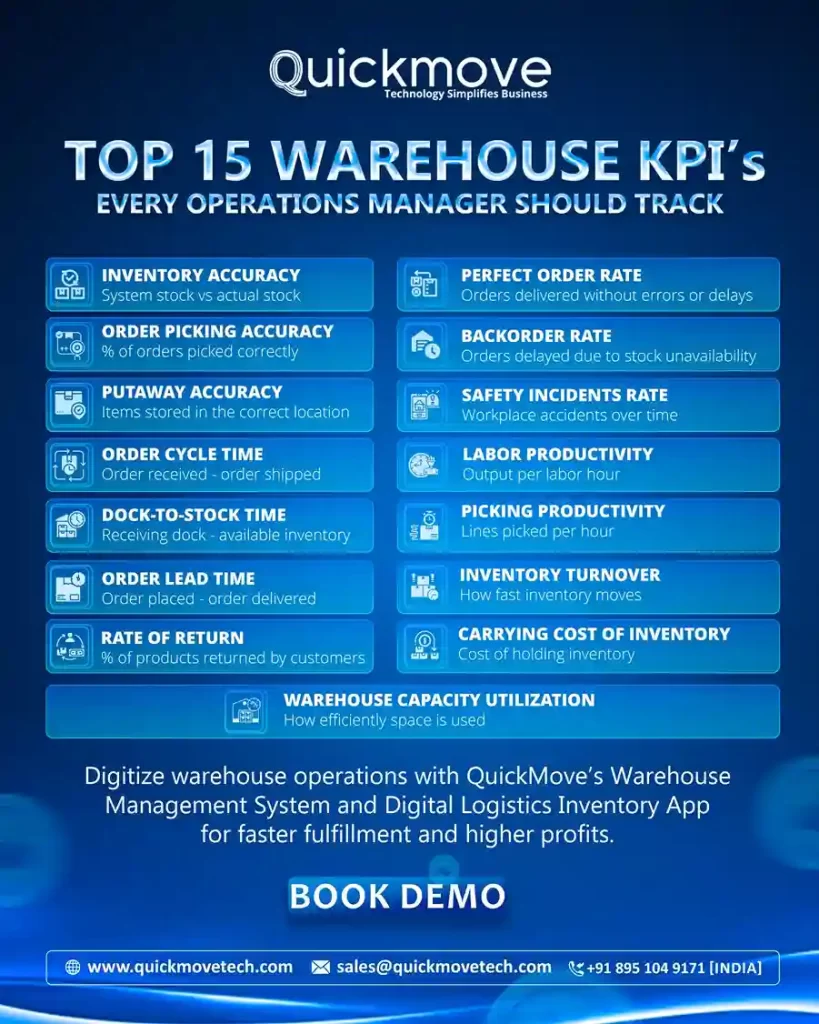
When measured and used correctly, warehouse KPIs help operations managers reduce waste, improve accuracy, increase productivity, and boost customer satisfaction. Let us discuss the top warehouse KPIs that you should track without fail:
1. Inventory Accuracy
Inventory accuracy compares what your system says you have versus what is actually on the shelves. Low accuracy creates customer complaints, delays, backorders, and unnecessary reordering.
Why it matters:
Without accurate inventory, the rest of your warehouse KPIs lose meaning. It also directly impacts customer trust.
How to improve:
- Regular cycle counting
- Barcode scanning
- Using a digital inventory app
- Keeping SKU data clean
Modern tools like QuickMove’s digital logistics inventory app make real-time updates and scanning much easier, improving accuracy significantly.
2. Order Picking Accuracy
Picking accuracy measures how many orders are picked correctly without errors. Even a small percentage of errors can cause returns, refunds, or customer dissatisfaction.
What affects this KPI:
- Human mistakes
- Poorly organized warehouse layout
- Wrong labeling
- Inaccurate inventory data
How to improve:
- Better slotting
- Clear signage
- Barcode-based picking
- WMS-driven picking routes
3. Order Cycle Time
Order cycle time is the total time from receiving an order to shipping it out. Customers expect fast delivery; long cycle times can cost you repeat business.
To reduce cycle time:
- Streamline picking and packing
- Use automation where possible
- Improve inventory visibility
- Reduce bottlenecks between departments
A warehouse management system (WMS) like QuickMove Technologies’ software can optimize picking sequences and track real-time movement to reduce delays.
4. Dock-to-Stock Time
This measures how long it takes from receiving goods at the dock to making them available in inventory. The faster this time, the quicker your warehouse can fulfill orders.
Common delays:
- Manual data entry
- Slow putaway processes
- Lack of staff during peak times
5. Perfect Order Rate
The perfect order rate shows the percentage of orders delivered without any issues—no damages, no backorders, no delays, and no inaccuracies.
Why it’s a big deal:
It sums up the entire quality of your warehouse process in one KPI.
How to improve it:
- Improving inventory accuracy
- Streamlining picking processes
- Reducing cycle time
- Using quality control checkpoints
6. Warehouse Capacity Utilization
This KPI shows how efficiently you are using your available space. Underutilization means wasted storage costs, while overutilization creates congestion and safety risks.
To get this right:
- Use vertical space wisely
- Implement slotting strategies
- Reorganize fast-moving and slow-moving SKUs
- Consider modular shelving or racks
7. Labor Productivity
Labor productivity measures how effectively your workforce operates—often viewed as units picked per hour or value processed per labor hour.
Why it’s important:
Labor is one of the highest warehouse costs. Improving productivity boosts profitability.
Improvement ideas:
- Provide clear SOPs
- Continuous staff training
- Performance dashboards
- Using digital tools to reduce manual tasks
8. Order Lead Time
Order lead time includes the total time from when the customer places the order to when they receive it. It includes cycle time, shipping time, and any internal delays.
How to reduce it:
- Speed up internal processing
- Improve supplier lead times
- Reduce picking errors
- Ensure accurate stock availability
9. Backorder Rate
Backorder rate shows how often orders cannot be fulfilled due to inventory unavailability.
High backorder rate means:
- Poor forecasting
- Poor inventory planning
- Inefficient reordering practices
Reduce backorders by:
- Tracking demand patterns
- Improving reorder triggers
- Maintaining safety stock for high-demand products
10. Inventory Turnover
Inventory turnover shows how many times inventory is sold and replaced in a given period. A higher turnover rate means products move faster and less capital is stuck in storage.
Benefits of high turnover:
- Lower holding costs
- Less risk of obsolete stock
- Better cashflow
Improve turnover by:
- Keeping SKU count optimized
- Eliminating dead stock
- Improving forecasting accuracy
- Strengthening supplier relationships
11. Rate of Return
This KPI shows how many products customers return after delivery. Some returns are unavoidable, but high return rates can signal product issues or inaccurate order fulfillment.
Reduce return rate by:
- Improving picking accuracy
- Better packaging
- Clear product descriptions
- Quality checks before shipping
12. Carrying Cost of Inventory
This measures the total cost of storing inventory. It includes storage space, utilities, insurance, depreciation, and staff handling costs.
Why it matters:
Excess inventory increases carrying costs and ties up working capital.
To reduce costs:
- Optimize reorder points
- Improve forecasting
- Eliminate dead or slow-moving stock
13. Putaway Accuracy
Putaway accuracy measures how often items are stored in the correct location after receiving.
Common mistakes leading to low accuracy:
- Manual data entry errors
- Wrong bin allocation
- Staff confusion due to poor labeling
- Lack of a putaway strategy
A structured WMS-guided putaway system—like the features provided in QuickMove Technologies’ warehouse management system—helps teams store every SKU in the right place with minimal errors.
14. Picking Productivity (Lines Picked per Hour)
This is one of the most important KPIs for operations managers. It shows how many order lines each picker completes per hour.
Why tracking this helps:
- Identifies top performers
- Shows who needs training
- Helps plan staffing for high-volume days
Ways to raise productivity:
- Good warehouse layout
- Zone picking
- Digital picking tools
- Reducing travel time between SKUs
15. Safety Incidents Rate
Warehouse operations can be hazardous. This KPI tracks how many safety incidents occur in a given period.
Benefits of tracking this KPI:
- Protects employee wellbeing
- Helps avoid legal liabilities
- Prevents downtime caused by accidents
Improving warehouse safety:
- Regular training
- Clear signage
- Proper lighting
- Equipment maintenance
- Reinforcing PPE requirements
Workplace safety isn’t just good practice—it directly affects productivity and employee morale.
Why Tracking Warehouse KPIs Is Important
Tracking warehouse KPIs is essential because it turns day-to-day warehouse activities into measurable data that operations managers can rely on for decision-making. In a high-speed, customer-driven supply chain environment, assumptions are no longer enough—KPIs provide the visibility required to stay competitive and efficient.
1. They Reveal Operational Inefficiencies Early
Without warehouse KPIs, inefficiencies often go unnoticed until they cause major delays or customer complaints. KPIs highlight issues such as slow order picking, inaccurate inventory counts, or rising labor costs before they escalate.
2. They Improve Customer Satisfaction
Metrics like order accuracy, cycle time, and perfect order rate directly influence customer experience. Tracking them ensures you catch errors quickly and deliver faster, more reliable service.
3. They Help Reduce Costs
Labor, storage, and transportation make up a significant portion of warehouse expenses. KPIs show where resources are being overused—helping operations managers cut waste, streamline processes, and optimize labor allocation.
4. They Enable Data-Driven Decision-Making
KPIs turn warehouse performance into measurable numbers. This allows managers to rely on facts rather than intuition when planning labor, forecasting inventory, or reorganizing layouts.
5. They Support Continuous Improvement
Warehouses that track KPIs consistently can monitor progress over time, run improvement initiatives, and benchmark performance. This drives a culture of ongoing optimization.
6. They Help Align Teams and Boost Accountability
When KPI dashboards are shared with teams, everyone understands performance expectations. This transparency boosts motivation, accountability, and collaboration.
7. They Create a Strong Foundation for Automation and Digital Systems
Modern tools like warehouse management systems and inventory apps depend on accurate data to deliver value. KPIs provide the structure needed for automation, making it easier to adopt digital workflows and scale efficiently.
How to Use These Warehouse KPIs Effectively
Having KPIs is useful, but the real value comes from how you use them:
1. Track KPIs Consistently
Daily, weekly, or monthly tracking helps you observe trends instead of reacting to isolated events.
2. Set SMART Targets
Specific, measurable, achievable, realistic, and time-bound targets give your team a clear direction.
3. Share KPI Dashboards with Your Team
Transparency helps employees understand what’s expected and motivates improvement.
4. Focus on the KPIs that Matter Most
Different warehouses have different goals. For example:
- High-volume warehouses may focus on picking accuracy and productivity.
- E-commerce warehouses may prioritize order cycle time.
- Third-party logistics (3PL) companies may emphasize perfect order rate and customer satisfaction.
5. Use a Modern Warehouse Management System
Tracking KPIs manually is difficult and prone to errors. A good WMS automates data capture, analysis, and reporting.
Solutions like QuickMove Technologies’ WMS are designed to give operations managers real-time visibility, accurate tracking, and automated reporting—making KPI monitoring faster and more reliable.
Final Thoughts
Warehouse KPIs are more than numbers—they’re insights into how your warehouse performs every single day.
The top 15 KPIs in this list cover all major areas of warehouse operations: inventory accuracy, order fulfillment, efficiency, space utilization, cost control, and employee performance. If you’re not tracking them already, now is the perfect time to start.
And while you can track some KPIs manually, operations managers achieve the best results when they use reliable digital tools. A modern solution like QuickMove Technologies’ warehouse management system and digital logistics inventory app makes KPI tracking easier, more accurate, and far more efficient helping you run a warehouse that is lean, responsive, and ready for the future.