Email Us
 Freight Forwarding Software
 Warehouse Management System
 Transport Management System
 Moving/Removal Software
 Customer Service Portal
 Move Survey Quote Pro
 Digital Logistics Inventory App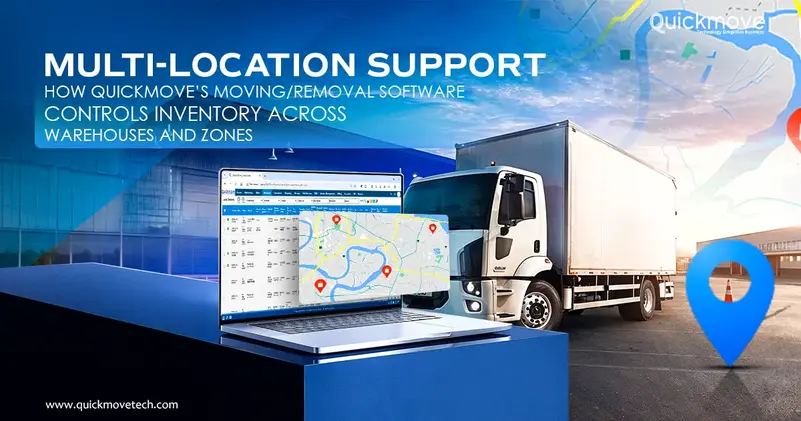
For moving and removal companies, expanding operations across multiple warehouses or storage zones is a sign of growth. However, it also introduces a significant operational challenge: maintaining accurate inventory control when goods are scattered across different locations, often in transit, or temporarily stored in different zones.
The days of managing this complexity with spreadsheets or disconnected systems are over. QuickMove’s moving/removal software provides a structured, automated approach to multi-location inventory management, ensuring that your business maintains control, accuracy, and efficiency as it scales.
The Growing Pains of Multi-Warehouse Inventory Management
When a moving company operates a single warehouse, inventory management is relatively straightforward. However, as you add new locations, the complexity multiplies. Common challenges include:
- Siloed Data: Stock levels in one warehouse are unknown to another, leading to inefficient order routing.
- Phantom Inventory: Manual tracking errors result in items listed as “in stock” that don’t actually exist on the shelf, or vice versa.
- Inefficient Fulfillment: Without a unified system, you might send a crew to a distant warehouse for items that are actually available at a closer location, wasting fuel and labor.
- Bin Drift: Over time, items get moved to different zones without system updates, creating a gap between digital records and physical reality.
QuickMove’s multi-location support directly tackles these issues by consolidating data from all your warehouses and zones into a single, unified source of truth.
Real-Time Inventory Visibility Across All Locations
The foundation of effective multi-location support is real-time visibility. QuickMove provides a centralized dashboard that offers a live view of inventory levels across every warehouse and zone.
This single source of truth empowers your team to:
- Check Stock Instantly: Know exactly what items are available at which warehouse at any given moment.
- Optimize Order Routing: Route jobs to the warehouse with the right inventory, minimizing unnecessary transfers and travel.
- Plan Effectively: Make informed decisions about restocking and resource allocation based on accurate, up-to-the-minute data.
This transparency eliminates guesswork and ensures your operations team is always working with the most accurate information available.
Zone Integrity: Preventing the Silent Killer of Warehouse Accuracy
Bin drift is the gradual degradation of location accuracy caused by manual overrides. A crew arrives at a warehouse, cannot find an item in its assigned zone, pulls it from an overflow section, and updates the job sheet but never updates the central database. Two weeks later, the system shows the item in the original zone, but it is actually in overflow.
QuickMove prevents this through forced reconciliation logic:
- Scan-to-Move Protocol: Every item transfer requires a source location scan and a destination location scan. The system will not close a removal order unless these scans match.
- Exception Flags: If a mover pulls an item from a zone different from the assigned one, QuickMove doesn’t just “update” the location. It flags the discrepancy and forces supervisor approval for a virtual reallocation
- Historical Trace: The system retains original zone data, allowing managers to audit why drift occurred whether from poor labeling, overcrowding, or crew shortcuts.
Availability vs. Accessibility: The Cold Zone Strategy
A common flaw in standard inventory systems is treating “available” as “accessible.” For a removal company, these are entirely different metrics.
An item might exist in your system as “In Stock,” but if it’s buried in a climate-controlled vault three miles from the loading bay, it’s not accessible for a same-day job.
QuickMove solves this by implementing a velocity-based zone hierarchy:
High-Velocity Zones (Near Loading Docks)
- Prioritized for short-term removal jobs.
- System queries these zones first for SKU availability.
- Designed for items that move frequently in and out.
- Minimizes crew travel time during peak operations.
Cold Zones (Deep Storage/Archival)
- Items scheduled for long-term storage are pushed here.
- System deliberately excludes them from standard removal queries.
- Only triggered when job type specifies “Long-Term Retrieval.”
- Prevents crews from wasting time digging through archival vaults for items meant for immediate delivery.
Granular SKU Management for Removal-Specific Items
Moving companies deal with varied, often fragile inventory furniture, electronics, art, and packing supplies. QuickMove supports complex SKU structures tailored to removal needs:
- Variant SKUs: Track different sizes, materials, or conditions of the same item type.
- Hierarchical SKUs: Group items under parent categories (e.g., “Living Room” -> “Sofa” -> “Leather Sofa“) for easier retrieval.
- Bundle SKUs: Combine multiple items into a single package for efficient tracking.
Every SKU can be linked to a specific physical location, such as a zone, rack, or bin, providing a clear map of where every item is stored. This granularity ensures that the right item not a similar one is loaded onto the correct truck from the correct warehouse.
Barcode-Driven Put-Away and Picking Processes
Efficient warehouse operations depend on the accuracy of put-away (storing items) and picking (retrieving items) processes. QuickMove digitizes these workflows with barcode and QR-code scanning.
Put-Away Optimization
When goods arrive, the system suggests the optimal storage location based on:

- Product velocity (how often the item moves)
- Size and weight constraints
- Zone capacity
Picking Optimization
For outbound jobs, QuickMove generates optimized pick lists that:
- Consolidate orders by zone
- Create efficient pick paths
- Direct pickers to the exact bin location
This systematic approach significantly improves productivity and reduces errors. Crew members spend less time walking and more time picking accurately.
Warehouse-to-Warehouse Transfers Without Data Loss
Inventory moves between locations constantly restocking, consolidation, or shifting items into storage. Without automation, these transfers create massive data gaps.
QuickMove automates the entire warehouse-to-warehouse transfer process:
- Automatic Debit/Credit: Stock levels update simultaneously at the sending AND receiving locations.
- In-Transit Status: Items in transfer are flagged as “floating” and excluded from availability calculations until scanned into the destination zone.
- Audit Trail: Every transfer generates a timestamped record, including who initiated it, what items moved, and when they arrived.
- Transit Storage Management: Items held temporarily between pickup and final delivery are tracked as a distinct operational stage.
This eliminates the administrative burden of manual double-entry and ensures zero inventory loss during transit.
Smart Order Routing: Reducing Fuel and Labor Waste
Routing a job to the wrong warehouse is expensive. QuickMove’s order routing logic minimizes this by:
- Proximity Mapping: The system automatically suggests the optimal fulfillment location based on the job’s origin and destination.
- Crew Assignment Integration: It syncs with crew availability data, ensuring the assigned team is closest to the warehouse holding the required inventory.
- Load Optimization: Inventory quantity is bound to spatial weight (cubic meters), preventing trucks from being over-allocated.
- Real-Time Adjustment: If a warehouse runs low on a specific item, the system reroutes future orders to locations with adequate stock.
- Result: fewer empty miles, shorter move-out windows, and higher crew productivity.
AI-Integrated Inventory Estimation Across Locations
QuickMove isn’t just a tracking tool; it actively predicts needs across zones using AI-driven estimation:
- Usage Pattern Analysis: The system analyzes historical data to predict which warehouses will need specific supplies during peak seasons.
- Automated Reorder Triggers: When stock in a specific zone drops below a threshold, the system flags it for restocking before a shortage occurs.
- Cost Projection: Material costs are automatically estimated per location, helping you budget accurately for each warehouse.
- Seasonal Adjustment: The AI recognizes seasonal patterns in moving demand and adjusts inventory recommendations accordingly.
This predictive layer transforms inventory management from reactive to proactive, preventing stockouts before they impact operations.
Reverse Logistics: Handling Claims Across Multiple Zones
Returns and damage claims are inevitable in moving. QuickMove simplifies this through centralized return tracking:
- Tracking ID Assignment: Every return request is logged with a unique ID linked to the original job and warehouse.
- Real-Time Status Updates: Whether goods are being inspected, repaired, or restocked, the system updates inventory status instantly.
- Cross-Zone Returns: If an item is returned to a different warehouse than it was shipped from, QuickMove automatically reconciles the stock levels at both locations.
- Claim Documentation: All return-related documentation is stored digitally, accessible from any location for dispute resolution.
This prevents the confusion of returned items “disappearing” from the system because they ended up in a non-origin warehouse.
Storage Billing and Cost Control Across Locations
A key financial aspect of multi-location operations is storage billing. QuickMove supports flexible storage billing models:
- Per-Unit Billing: Charge based on the number of items stored.
- Fixed Storage Billing: Flat rate for a designated storage space.
- Fixed Per-Unit Billing: Combination of fixed space fees plus per-item charges.
- Time-Based Billing: Adjust rates based on storage duration.
This is fully integrated with the accounting system, enabling accurate and timely invoicing for stored goods. This feature is essential for moving companies that offer storage services, as it eliminates guesswork and ensures profitability.
Real-Time Dashboards for Operations Managers
QuickMove provides a centralized dashboard that aggregates data from all zones:
- Live Stock Counts: See exactly what’s available in every warehouse at a glance.
- Transfer Status: Track pending and in-progress transfers across locations.
- Discrepancy Alerts: Immediate notifications when inventory counts don’t match physical scans.
- Performance Metrics: Identify which zones have the highest picking errors or slowest retrieval times.
- Utilization Rates: Monitor warehouse capacity across all locations to plan expansions or consolidations.
Eliminating Data Silos: The Unified Platform Advantage
The most overlooked benefit of QuickMove’s multi-location support is data consolidation. When you use separate spreadsheets, QuickBooks files, and warehouse logs, you’re operating with fragmented information.
QuickMove breaks down these silos by:
- Integrating with Financial Tools: Syncs inventory value directly with your accounting system.
- Centralizing Customer Data: Links all inventory to specific client job IDs for easy lookup during disputes.
- Unified Reporting: Generate reports that span all locations for comprehensive business analysis.
- Role-Based Access: Control which managers have visibility and edit rights over specific locations.
One platform. One source of truth. Zero duplication errors.
Scaling Without Breaking: How QuickMove Grows With You
As you add new warehouses or expand into new cities, your inventory complexity multiplies. QuickMove’s architecture scales seamlessly:
- Add Unlimited Zones: No caps on the number of warehouses or zones you can manage.
- Custom Workflows: Configure different picking, packing, and transfer rules for each zone based on its specific operational needs.
- User Permissions: Granular control over who can access, edit, or approve inventory actions in each location.
- Modular Features: Add capabilities like advanced analytics or AI estimation as your needs evolve.
You don’t need to retrain your team or overhaul processes when you expand. The system adapts.
The Bottom Line: Moving From Chaos to Control
Multi-location inventory management isn’t about having more data it’s about having actionable data. QuickMove’s moving/removal software gives you:
- Zero Guesswork: Every item’s location is verified and traceable.
- Lower Costs: Optimized routing and reduced double-handling directly impact your bottom line.
- Fewer Disputes: Accurate tracking means customers get what they ordered, when and where they expected it.
- Scalable Operations: Add new locations without losing control of your inventory.
- Better Resource Allocation: Know exactly where your assets are and deploy them efficiently.
Stop letting spreadsheets and gut instincts dictate your warehouse operations. QuickMove provides the structure, automation, and visibility you need to run a profitable, multi-location removal business.