Email Us

 Freight Forwarding Software
 Warehouse Management System
 Transport Management System
 Moving/Removal Software
 Service Portal
 Move Survey Quote Pro
 Digital Logistics Inventory App
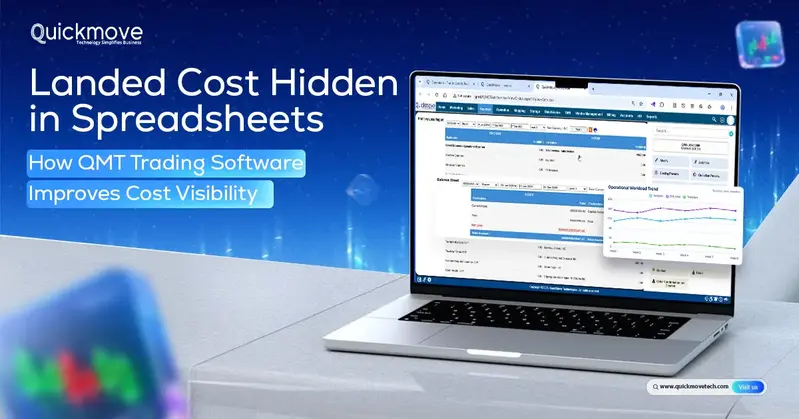
In international trade, the purchase price of a product is only one part of its total cost. Freight charges, import duties, insurance, customs fees, clearing expenses, and handling charges can significantly increase the final cost of goods. However, when these expenses are tracked across multiple spreadsheets, invoices, and accounting records, businesses often struggle to determine the actual cost of each product.
This lack of visibility can lead to inaccurate product pricing, reduced profit margins, and unreliable financial reporting. QMT Logistics Trading Software helps businesses overcome these challenges by bringing landed cost allocation into a more structured and transparent process.
What Is Landed Cost in Trading?
Landed cost refers to the total cost of acquiring a product and bringing it to its intended destination, ready for sale or further distribution.
It includes more than the supplier’s invoice value. Depending on the transaction, landed cost may include:
- Freight charges: Costs associated with transporting goods by sea, air, road, or rail.
- Import duties and taxes: Applicable customs duties and other import-related charges.
- Insurance: Coverage for goods during transit.
- Customs clearance: Fees for documentation, customs processing, and clearance services.
- Clearing charges: Expenses incurred through clearing agents and other service providers.
- Handling charges: Loading, unloading, warehousing, and port handling expenses.
Accurately allocating these expenses to the correct products and goods receipts is essential for understanding the true cost of inventory and making informed purchasing and pricing decisions.
Why Landed Cost Gets Hidden in Spreadsheets
Many trading businesses rely on spreadsheets to calculate landed costs. While spreadsheets may work for simple transactions, they become increasingly difficult to manage as shipment volumes, product varieties, and supplier relationships grow.
1. Expenses Are Recorded in Different Places
A supplier invoice may be stored in one spreadsheet, freight charges in another, and customs expenses in a separate accounting record. Bringing these figures together requires manual effort and creates opportunities for errors.
2. Costs Are Not Allocated to the Right Products
A single shipment may contain multiple products with different quantities, weights, values, and handling requirements. Dividing the total shipment cost equally across all items may produce misleading product costs.
3. Delayed Invoices Create Incomplete Cost Records
Freight, insurance, and customs invoices may arrive after goods have been received into inventory. If these additional expenses are not linked back to the original receipt, inventory values and product profitability calculations may remain incomplete.
4. Manual Calculations Increase the Risk of Errors
Formula mistakes, duplicate entries, outdated spreadsheets, and inconsistent allocation methods can distort the final landed cost. Even small inaccuracies can affect margins when repeated across hundreds of transactions.
5. Profitability Becomes Difficult to Measure
When additional costs are not assigned correctly, a product may appear more profitable than it actually is. Businesses may set selling prices based on incomplete cost information, leading to unexpected margin erosion.
How QMT Trading Software Helps Manage Landed Costs
QMT Trading Software helps trading businesses bring greater structure and visibility to purchasing, inventory, and cost management. By connecting relevant transaction records and supporting systematic cost allocation, a trading management solution can reduce dependence on disconnected spreadsheets.
1. Allocate Freight Costs to the Correct Products
Freight is often one of the largest additional expenses associated with imported goods. When a shipment contains several product lines, the freight amount needs to be distributed using an appropriate allocation basis.
Depending on the shipment, allocation may be based on product value, quantity, weight, or volume.
QMT Trading Software can support a more organized approach to tracking freight expenses against relevant purchases and receipts, helping businesses understand how transportation costs contribute to product-level costs.
2. Include Duties, Insurance, and Customs Expenses
Import duties, insurance premiums, customs clearance fees, and other charges all contribute to the final cost of acquiring goods.
When these expenses are recorded separately, finance and purchasing teams may struggle to reconcile them with the original transaction.
A structured landed cost process helps businesses associate these expenses with the relevant shipment, purchase, and product receipt. Where supported by the configured workflow, QMT can help centralize these records and improve cost traceability.
3. Link Additional Costs to Goods Receipts
A goods receipt confirms that products have arrived and have been recorded in inventory. However, the full cost of those products may not be known at the time of receipt.
For example, goods may arrive before the freight forwarder or clearing agent submits the final invoice.
Connecting additional expenses to the relevant purchase and receipt helps businesses maintain a clearer record of the costs associated with incoming inventory. It also supports reconciliation when late-arriving invoices need to be accounted for.
4. Improve Product-Level Cost Visibility
Shipment-level expenses do not always affect every product equally. Heavy, bulky, high-value, and fragile items may have different transportation, insurance, or handling requirements.
An appropriate allocation method distributes costs according to the characteristics of the shipment rather than relying on arbitrary estimates.
With better product-level cost information, businesses can evaluate purchasing decisions, review pricing strategies, and identify products whose actual margins differ from expectations.
5. Reduce Manual Spreadsheet Work
Maintaining several spreadsheets requires repeated data entry, formula checks, and manual reconciliation. As transaction volumes increase, this approach becomes harder to control.
A centralized logistics trading management workflow can reduce duplicate data handling and provide a consistent place to review relevant purchase, receipt, and expense records.
The result is a more reliable process for tracking landed costs, subject to the software’s configured features and accounting integrations.
The supplier’s invoice alone indicates a unit cost of ₹500. However, including the additional expenses increases the cost to ₹640 per unit.
That is a difference of ₹140 per unit, or ₹1,40,000 across the shipment.
If the business prices its products using only the supplier invoice, it risks overstating its gross margin. With a structured landed cost process, the business can work with a more complete cost figure when evaluating profitability.
Benefits of Better Landed Cost Management
By reducing fragmented cost tracking and improving allocation practices, trading businesses can gain several operational advantages.
- More accurate product costing: Include relevant import and transportation expenses when calculating inventory costs.
- Better pricing decisions: Set selling prices using a more complete understanding of acquisition costs.
- Improved margin visibility: Identify products and transactions where additional charges are affecting profitability.
- Stronger reconciliation: Trace expenses back to the relevant shipments, purchases, and receipts.
- Less manual work: Reduce repetitive spreadsheet updates and formula-dependent calculations.
- Better purchasing decisions: Compare suppliers and sourcing options using a broader view of total acquisition costs.
Why Trading Businesses Need a Structured Costing Process
As trading operations expand, managing landed costs through spreadsheets becomes increasingly challenging. More shipments mean more invoices, more expense categories, and more opportunities for costs to be overlooked or allocated incorrectly.
A structured trading software solution helps businesses move towards consistent cost tracking, clearer transaction records, and better visibility into the financial impact of each shipment.
For businesses managing multiple suppliers, international purchases, and diverse product categories, landed cost management is not simply an accounting task. It is an important part of inventory control, pricing, and profitability management.
Conclusion
Landed costs hidden in spreadsheets can make inventory appear cheaper than it really is and product margins look healthier than they actually are. Freight, duties, insurance, customs, clearing, and handling expenses must be connected to the right products and receipts to provide a realistic picture of acquisition costs.
QMT Logistics Trading Software offers trading businesses a way to bring greater organization to their purchasing and inventory workflows. By supporting structured expense tracking and landed cost allocation, it can help businesses improve cost visibility, reduce reliance on disconnected spreadsheets, and make more informed commercial decisions.
The goal is simple: understand the true cost of every product, maintain better control over expenses, and protect profitability with more reliable information.