Email Us

 Freight Forwarding Software
 Warehouse Management System
 Transport Management System
 Moving/Removal Software
 Customer Service Portal
 Move Survey Quote Pro
 Digital Logistics Inventory App
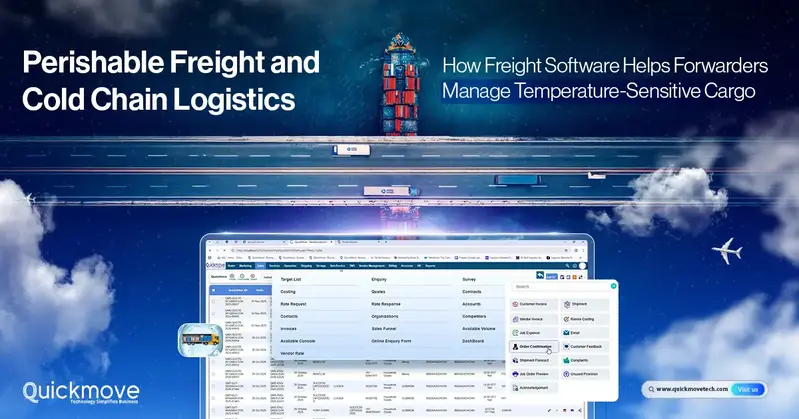
Perishable freight requires more than simply moving goods from one location to another. Fresh produce, seafood, pharmaceuticals, flowers, frozen products, and other temperature-sensitive cargo require careful planning, fast communication, accurate documentation, and continuous operational visibility.
For freight forwarders, managing these shipments manually can become increasingly difficult as shipment volumes grow. Teams may need to coordinate quotations, bookings, documentation, transportation, tracking, billing, customer communication, and delivery while also managing time-sensitive cargo requirements.
This is where freight forwarding software can make a significant difference.
Modern digital freight software helps forwarders bring key logistics processes together in one platform, automate repetitive tasks, improve shipment visibility, and maintain better control over operational and financial performance.
For businesses managing multiple modes and logistics activities, an integrated platform such as QuickMove can connect freight forwarding with transport, warehouse, accounting, customer service, and other business processes.
What Is Perishable Freight?
Perishable freight refers to goods that can deteriorate, lose quality, or become unusable if they are exposed to unsuitable temperature conditions, excessive delays, or improper handling.
Common examples include:
- Fresh fruits and vegetables
- Seafood
- Meat and poultry
- Dairy products
- Flowers and plants
- Pharmaceuticals
- Vaccines and biologics
- Frozen food
- Temperature-sensitive chemicals and products
Unlike standard dry cargo, perishable shipments are affected by both transportation time and cargo condition.
A shipment may arrive at its destination on schedule but still lose value if the cargo has been exposed to unsuitable conditions.
This makes visibility and operational control especially important for freight forwarders.
Why Perishable Freight Requires Better Logistics Management
A conventional freight shipment is generally managed through bookings, documentation, transportation milestones, customs processes, and delivery.
Perishable freight adds another layer of complexity.
Forwarders may need to manage:
- Temperature requirements
- Reefer container information
- Shipment cut-off times
- Transit time
- Cargo shelf life
- Inspection requirements
- Customs documentation
- Delivery schedules
- Customer communication
- Exceptions and delays
The reference material highlights that perishable logistics differs from general freight because it introduces additional data and risk considerations, including reefer set points, temperature readings, and shelf-life considerations.
For a growing freight forwarding company, managing all of this through spreadsheets, emails, and disconnected systems can create unnecessary manual work.
How Freight Forwarding Software Supports Perishable Cargo
The purpose of freight forwarding software is not simply to track a shipment.
A comprehensive system can connect multiple stages of the freight lifecycle.
For example:
Enquiry → Quotation → Booking → Job Creation → Documentation → Shipment Tracking → Costing → Billing → Delivery → Profitability Analysis
QuickMove’s Freight Suite is designed to support air, sea, and road shipments, including FCL, LCL, and groupage, with shipment tracking, documentation, and integrated billing.
This type of connected workflow can help freight forwarders manage perishable shipments more efficiently while keeping operational and financial information connected.
8 Ways Freight Software Can Improve Perishable Logistics
1. Faster Quotation and Rate Management
Perishable shipments often require fast responses because customers may be working with limited shelf-life windows.
Delays at the quotation stage can affect the entire shipment timeline.
A modern freight management software platform can help teams manage rates, estimates, and quotations more efficiently.
QuickMove includes capabilities such as contract rates, similar-rate references, automatic costing, and estimation tools. These features can help teams prepare quotes faster while maintaining better cost and margin visibility.
Instead of repeatedly searching through old spreadsheets, teams can use previous estimates and structured rate information to support faster decision-making.
2. Better Shipment and Job Management
Once a customer confirms a shipment, the next challenge is managing the operational workflow.
A freight forwarding team may need to coordinate:
- Booking details
- House and master shipment information
- Cargo information
- Documentation
- Carrier details
- Origin and destination activities
- Transportation
- Delivery
QuickMove’s freight solution supports shipment and job management across air, sea, and road freight, helping companies manage their operational lifecycle from a centralized platform.
This is particularly useful for businesses handling multiple shipments simultaneously.
3. Real-Time Shipment Visibility
Visibility is critical when dealing with time-sensitive cargo.
A delayed vessel, flight, truck, customs process, or delivery appointment can affect the condition and commercial value of perishable goods.
With digital freight software, operations teams can monitor shipment milestones and identify delays earlier.
QuickMove supports real-time shipment and milestone tracking within its freight solution.
4. Automated Documentation
Documentation is one of the most time-consuming parts of freight forwarding.
Perishable shipments can require multiple documents and coordination between customers, carriers, agents, customs teams, and other stakeholders.
Manual document preparation can increase the possibility of:
- Data-entry mistakes
- Missing information
- Duplicate work
- Delayed document sharing
- Communication gaps
QuickMove’s Freight Suite supports automated documentation for key freight documents such as BL and AWB, helping teams reduce repetitive administrative work.
Its AI capabilities can also extract shipment information from uploaded BL, LR, or AWB documents and use that information to create job orders, reducing manual data entry.
5. Better Cost and Profitability Control
Perishable freight can involve additional costs related to handling, storage, transportation, delays, and other operational activities.
If these costs are not tracked accurately, a shipment that appears profitable at the quotation stage may generate a much smaller margin after completion.
This is where freight management software becomes particularly valuable.
QuickMove provides integrated billing, cost-sheet management, and profitability visibility. Its platform also includes profitability control intelligence to help businesses monitor financial performance.
For freight forwarders, this creates an important connection between:
Revenue → Cost → Margin → Profitability
Instead of evaluating shipments only by revenue, management can gain better visibility into the actual financial performance of jobs.
6. Automated Billing and Invoicing
Billing delays can create cash-flow problems for logistics businesses.
Manual invoice preparation can also result in incorrect charges, missed costs, and unnecessary administrative work.
QuickMove includes automatic invoicing and financial workflow capabilities designed to automate invoices, payments, accounting entries, and financial reporting.
For freight forwarders managing large numbers of shipments, automation can reduce repetitive work and help finance and operations teams work from more consistent shipment data.
7. Customer Self-Service and Shipment Updates
Customers increasingly expect visibility without having to contact their freight forwarder for every update.
A customer service portal can help customers access shipment information, documents, and updates directly.
QuickMove provides a customer portal where customers can track shipments, access documents, and receive real-time updates.
This can reduce repetitive status-update requests while giving customers greater transparency.
For perishable cargo, timely communication is particularly important because customers need to understand shipment progress and potential delays.
8. Connect Freight, Warehouse, and Transport Operations
Perishable logistics rarely ends at the port or airport.
Cargo may move through:
Supplier → Freight Forwarder → Warehouse → Port/Airport → Transport → Customer
When these operations are managed through disconnected systems, information can become fragmented.
QuickMove takes an integrated approach by combining freight forwarding, warehouse management, transport management, accounting, CRM, and customer-facing tools within its broader logistics platform.
This can help companies create greater visibility across the complete logistics process.
Perishable Freight Software vs. Traditional Manual Processes
The difference between manual processes and digital freight management becomes especially clear as shipment volumes increase.
| Traditional Process | Digital Freight Software |
| Spreadsheet-based shipment tracking | Centralized shipment tracking |
| Manual quotation preparation | Automated costing and estimation |
| Repeated data entry | Automated job creation |
| Manual document preparation | Automated documentation |
| Separate billing systems | Integrated billing |
| Manual customer updates | Customer self-service portal |
| Limited profitability visibility | Job-level cost and margin visibility |
| Disconnected freight, warehouse and transport data | Integrated logistics operations |
For smaller freight operations, spreadsheets may initially appear manageable.
However, as shipment volumes, customers, employees, and operational complexity increase, manual processes can become difficult to control.
The Role of AI in Modern Freight Management
Artificial intelligence is becoming increasingly relevant to logistics operations.
Instead of using AI only for analytics, modern logistics platforms can use AI to automate repetitive operational activities.
QuickMove currently highlights AI-enabled capabilities including:
- AI-powered vendor invoice creation
- Smart automatic costing
- Automated job-order creation
- Automated job-order creation
- AI-enabled labeling solutions
The platform uses AI to extract information from uploaded documents and reduce manual data entry in logistics workflows.
For freight forwarders, this can help employees spend less time entering information and more time managing customers, exceptions, and operational decisions.
Managing Perishable Cargo Across Air, Sea, and Road
Different transportation modes create different operational requirements.
Air Freight
Air freight is often used when speed is critical.
For temperature-sensitive cargo, delays in documentation, handling, or airport processes can affect shipment timelines.
Freight forwarding software can provide visibility into bookings, AWBs, milestones, documentation, and billing.
Ocean Freight
Ocean transportation can provide cost advantages but usually involves longer transit times.
For perishable ocean cargo, shipment visibility and planning become particularly important.
QuickMove supports FCL, LCL, and groupage operations as part of its Freight Suite.
Road Transportation
Road transportation is often an important part of the first-mile or last-mile journey.
Once cargo arrives at a port or airport, it may still need to travel to a warehouse, distribution center, or final customer.
QuickMove’s Transport Management System supports shipment planning, route optimization, real-time vehicle tracking, trip management, fuel monitoring, and delivery performance analysis.
Connecting freight and transportation workflows can therefore provide greater end-to-end visibility.
Common Challenges in Perishable Freight Operations
Freight forwarders handling temperature-sensitive cargo may encounter several challenges.
Shipment Delays
A delay can reduce the remaining shelf life of the cargo.
Manual Data Entry
Repeatedly entering shipment information into multiple systems increases the possibility of errors.
Poor Cost Visibility
Additional charges may not be identified until after the shipment is completed.
Documentation Gaps
Missing or incorrect documentation can create operational delays.
Limited Customer Visibility
Customers may repeatedly contact the operations team for shipment updates.
Disconnected Systems
When freight, warehouse, transport, and accounting systems operate separately, management may struggle to obtain a complete picture of the shipment.
Difficulty Scaling Operations
Manual processes that work for 50 shipments may become inefficient when a business manages hundreds or thousands of shipments.
How QuickMove Can Support Perishable Freight Operations
QuickMove is positioned as an end-to-end logistics software platform covering freight, transport, warehouse, moving, CRM, ERP, accounting, HR, payroll, and customer service capabilities.
For freight forwarders managing perishable cargo, relevant capabilities include:
Freight Forwarding: Manage air, sea, and road shipments with FCL, LCL, and groupage workflows.
Shipment Tracking: Monitor shipment milestones and improve operational visibility.
Documentation: Automate key freight documentation and reduce repetitive administrative work.
AI Automation: Use AI-powered workflows for invoice processing, costing, job creation, and enquiries.
Automatic Costing: Generate faster and more consistent logistics cost estimates.
Profitability Control: Monitor shipment-level costs and profitability.
Automatic Invoicing: Reduce manual billing processes and improve financial workflow efficiency.
Customer Portal: Give customers access to shipment information and documents.
Warehouse Management: Manage inventory and warehouse activities through digital workflows.
Transport Management: Plan routes, manage trips, track vehicles, and monitor transportation performance.
These capabilities allow QuickMove to address more than one part of the logistics operation rather than functioning only as a shipment-tracking system.
What Should Freight Forwarders Look for in Perishable Freight Software?
Before choosing a perishable freight software solution, companies should evaluate whether the platform can support their actual operational requirements.
Consider the following questions:
- Can the software manage air, sea, and road freight?
- Does it provide real-time shipment visibility?
- Can it automate documentation?
- Can it manage quotations and contract rates?
- Does it provide automatic costing?
- Can it track shipment-level profitability?
- Does it automate billing and invoicing?
- Can customers access shipment information online?
- Can the platform integrate freight, warehouse, and transport operations?
- Does it provide AI-powered automation?
- Can it reduce repetitive manual data entry?
- Can the system scale with business growth?
The answer should be based on the actual workflows your organization needs rather than simply the number of features listed on a software vendor’s website.
Why Integrated Logistics Software Matters for Growing Freight Forwarders
As freight forwarding companies grow, they often add new customers, employees, locations, transportation partners, warehouses, and shipment volumes.
Without an integrated system, each additional layer can create more spreadsheets, emails, manual processes, and disconnected data.
An integrated logistics software platform provides a different approach.
Instead of managing freight, transportation, warehousing, accounting, and customer service independently, businesses can connect these functions within one technology ecosystem.
QuickMove’s platform is designed around this integrated approach, combining CRM, ERP, accounting, HR, payroll, customer portal, freight, warehouse, transport, and other logistics capabilities.
Conclusion
Perishable freight requires careful planning, fast communication, strong shipment visibility, accurate documentation, and effective cost control.
For freight forwarders, managing these activities manually can become increasingly difficult as business volumes grow.
Freight forwarding software can help bring these processes together by connecting quotations, bookings, documentation, shipment tracking, costing, billing, customer communication, and profitability management.
For businesses handling temperature-sensitive cargo, the objective is not simply to move a shipment from origin to destination.