Email Us
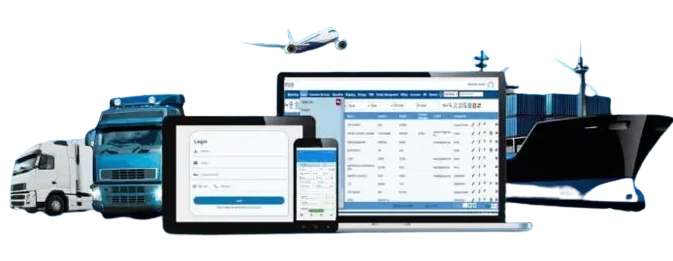
 Freight Forwarding Software
 Warehouse Management System
 Transport Management System
 Moving/Removal Software
 Customer Service Portal
 Move Survey Quote Pro
 Digital Logistics Inventory App
The logistics and freight forwarding industry in the Middle East is evolving fast. With growing international trade, increasing customer expectations, and government-led digital transformation initiatives across countries like the UAE, Saudi Arabia, Qatar, Oman, and Bahrain, freight forwarders are actively looking for smarter ways to manage operations.
Traditional spreadsheets methods and disconnected systems are no longer enough to handle complex shipping processes, customs documentation, shipment tracking, billing, and customer communication, this is why many logistics companies are now investing in cloud-based freight forwarding software.
But with several platforms available in the market, choosing the right solution can be challenging and time consuming. For this reason we are prepared for this guide, here we compare leading cloud freight forwarding solutions available in the Middle East, highlighting their strengths, limitations, and the key factors businesses should consider before making an investment.
Why Cloud Freight Forwarding Software Is Becoming Essential and important for all logistics business owner
Cloud-based freight forwarding solutions offer several benefits over traditional on-premise systems.
Key benefits include:
- Real-time shipment visibility
- Remote access from any location
- Automated documentation
- Faster customs processing
- Improved customer communication
- Reduced operational costs
- Better scalability for growing businesses
- Enhanced data security and backup
Key Features to Look for in a Cloud Freight Forwarding Platform
Before comparing, it is important to understand what modern freight forwarders need.
A robust cloud freight forwarding software should provide:
1. Shipment Management
Ability to manage air, sea, road, and multimodal shipments from a single platform.
2. Documentation Automation
Automatic generation of:
- Bill of Lading (BL)
- Air Waybill (AWB)
- Commercial Invoices
- Packing Lists
- Customs Documents
3. Customs & Compliance Management
Tools that simplify customs filing and regulatory compliance.
4. Customer Portal
Allow customers to track shipments and access documents in real time.
5. Financial Management
Integrated accounting, invoicing, cost control, and profitability analysis.
6. Reporting & Analytics
Real-time dashboards and operational insights.
7. Cloud Accessibility
Secure access from any location with automatic updates and backups.
Leading Cloud Freight Forwarding Software Solutions in the Middle East
Here are the Leading Cloud Freight Forwarding Solutions software companies in the Middle East:
1. QuickMove
QuickMove Technologies offers a modern cloud-based freight forwarding software built specifically for freight forwarders, logistics providers, customs brokers, and 3PL companies. Unlike many traditional systems, QuickMove combines freight operations, CRM, accounting, HR, customer portals, and workflow automation into a single platform.
Strengths:
- Fully cloud-based platform
- Air, sea, road, and multimodal shipment management
- Automated freight documentation
- Real-time shipment tracking
- Integrated accounting and invoicing
- Customer and agent portal
- Customs and compliance management
- Workflow automation and AI-enabled features
- Scalable for growing logistics businesses
Limitations:
- Feature requirements may vary based on business size and operational complexity.
- Companies should evaluate integration, customization, and workflow needs before selecting a platform.
- A personalized demo can help determine the best fit for specific logistics operations.
Why Businesses Choose QuickMove
- Purpose-built for freight forwarders, NVOCCs, and logistics providers
- Modern cloud architecture with anywhere, anytime access
- Faster implementation compared to many traditional enterprise systems
- User-friendly interface that minimizes training requirements
- End-to-end operational visibility from booking to delivery
- Integrated CRM, accounting, HR, and customer portal in a single platform
- Scalable solution designed to support growing logistics businesses
2. CargoWise
CargoWise is one of the most recognized freight forwarding platforms globally and is widely used by large logistics providers.
Strengths:
- Comprehensive global logistics management
- Strong customs compliance capabilities
- Multi-country operations support
- Extensive integrations
Limitations:
- High implementation costs
- Complex setup process
- Requires extensive training
- Often better suited for large enterprises
3. Magaya
Magaya provides cloud-based logistics software with freight management, warehouse management, and accounting capabilities.
Strengths:
- Freight forwarding management
- Warehouse integration
- Cargo tracking tools
- Accounting modules
Limitations:
- Can become expensive as operations grow
- Some users report support and feature-integration challenges.
4. Logi-Sys
Logi-Sys is a logistics ERP solution designed specifically for freight forwarders, NVOCCs, and customs brokers.
Strengths:
- End-to-end freight forwarding management
- Customs clearance support
- Integrated finance modules
- Multi-branch operations
Limitations:
- Customization may require additional implementation effort
- User experience can vary depending on deployment requirements
A Detailed Comparison of Leading Freight Forwarding Platforms:
| Feature | QuickMove | CargoWise | Magaya | Logi-Sys |
|---|---|---|---|---|
| Cloud-Based | Yes | Yes | Yes | Yes |
| Air Freight Management | Yes | Yes | Yes | Yes |
| Sea Freight Management | Yes | Yes | Yes | Yes |
| Road Transport Management | Yes | Yes | Limited | Yes |
| Customs Management | Yes | Yes | Yes | Yes |
| Automated Documentation | Yes | Yes | Yes | Yes |
| Customer Portal | Yes | Yes | Yes | Yes |
| Integrated Accounting | Yes | Yes | Yes | Yes |
| CRM Integration | Advanced | Limited | Limited | Limited |
| Workflow Automation | Advanced | Yes | Moderate | Moderate |
| Suitable for SMEs | Excellent | Moderate | Good | Good |
| Enterprise Scalability | Excellent | Excellent | Good | Good |
Which Cloud Freight Forwarding Solution Is Best for Middle East Logistics Companies?
The answer depends on your business size, operational complexity, and growth plans.
Choose QuickMove If:
- You want an all-in-one freight forwarding platform.
- You need automation, visibility, and integrated accounting.
- You are looking for a scalable cloud solution without enterprise-level complexity.
- You want a platform designed specifically for modern freight forwarding operations.
Choose CargoWise If:
- You operate globally.
- You have large enterprise requirements.
- Budget is not a primary concern.
Choose Magaya If:
- You need freight and warehouse management together.
- You are a growing logistics provider.
Choose Logi-Sys If:
- You require ERP-focused logistics management.
- You operate multiple branches.
Future of Cloud Freight Forwarding Software in the Middle East
The future of freight forwarding in the Middle East will be driven by:
- Artificial Intelligence (AI)
- Workflow automation
- Digital customs processing
- Predictive analytics
- Customer self-service portals
- Real-time shipment visibility
- Integrated logistics ecosystems
Companies that adopt modern cloud freight forwarding solutions today will be better positioned to improve operational efficiency, reduce costs, and deliver superior customer experiences.
Conclusion
As the Middle East continues to strengthen its position as a global logistics hub, freight forwarders need technology that can support growth, compliance, and operational excellence.
While platforms like CargoWise, Magaya, and Logi-Sys remain established options, modern cloud-based solutions such as QuickMove Technologies are helping logistics companies simplify operations, automate workflows, and gain complete visibility across their supply chains.
The right software should not only manage shipments but also help your business improve profitability, customer satisfaction, and long-term scalability. By carefully evaluating your operational needs, you can choose a freight forwarding solution that supports your growth across the Middle East and beyond.