Email Us
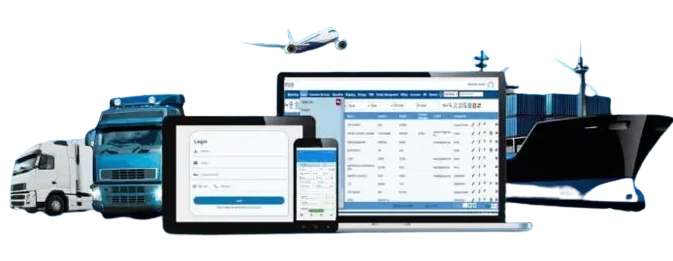
 Freight Forwarding Software
 Warehouse Management System
 Transport Management System
 Moving/Removal Software
 Customer Service Portal
 Move Survey Quote Pro
 Digital Logistics Inventory App
The freight forwarding industry is undergoing a major transformation.
Global supply chains are becoming more complex, customer expectations are rising, and logistics businesses are under constant pressure to improve efficiency while controlling costs.
Traditional operational methods built around spreadsheets, emails, and disconnected applications are no longer enough to support modern logistics.
The future of freight forwarding will not be defined by moving more cargo. It will be defined by how intelligently logistics companies manage their operations.
This is where modern logistics software becomes a strategic advantage.
The Growing Complexity of Freight Forwarding
Every shipment today involves multiple stakeholders, transportation modes, regulatory requirements, and operational workflows.
A single shipment may require coordination between:
- Ocean Freight
- Air Freight
- Road Transport
- Customs Clearance
- Warehousing
- Documentation Teams
- Overseas Agents
- Customers and Consignees
- Finance Teams
When these processes operate on separate systems, businesses experience delays, duplicate work, communication gaps, and limited visibility.As freight volumes grow, operational complexity grows even faster.Without the right technology, scaling becomes increasingly difficult.
Why Logistics Software Has Become a Business Strategy
Modern logistics software is no longer simply an operational tool. It has become the foundation for building scalable logistics businesses.
Instead of managing information across multiple applications, leading freight forwarders are adopting integrated logistics platforms that connect every department within a single digital ecosystem.
The result is:
- Better collaboration
- Faster decision-making
- Standardized workflows
- Improved customer experience
- Complete operational visibility
The software no longer supports the business. It powers the business.
Operational Visibility Is the New Competitive Advantage
Today’s customers expect transparency throughout the shipping process.
They want instant shipment updates, accurate documentation, proactive communication, and faster issue resolution.
Meeting these expectations requires more than experienced teams.
It requires software that delivers real-time visibility across the entire logistics operation.
Organizations with complete operational visibility can identify bottlenecks early, respond faster to disruptions, and provide a significantly better customer experience.
Visibility has become one of the strongest competitive differentiators in freight forwarding.
Unified Platforms Are Replacing Disconnected Systems
Many logistics companies continue to use separate applications for freight operations, warehouse management, accounting, CRM, finance, and customer communication.
While each system performs its own function, disconnected platforms create data silos that reduce productivity.
The future belongs to unified logistics software that brings every operational function into one connected platform.
With a centralized system, logistics businesses can manage:
- Freight Forwarding
- Transport Management
- Warehouse Operations
- Customer Relationship Management
- Financial Management
- Documentation
- Workflow Automation
- Performance Analytics
A single source of operational data enables teams to work faster and leadership to make more informed decisions.
Data Is Becoming the Most Valuable Asset in Logistics
Every shipment generates valuable operational data.
The challenge is not collecting data it is converting it into actionable insights.
Modern logistics software enables decision-makers to answer questions such as:
- Which customers generate the highest profitability?
- Which trade lanes perform best?
- Which carriers consistently deliver on time?
- Where do operational delays occur most frequently?
- Which workflows require optimization?
Real-time analytics help logistics leaders make proactive decisions instead of reacting to problems after they occur.
Building Scalable Logistics Operations
Business growth should not require proportionally increasing operational effort.
Scalable logistics organizations rely on standardized workflows, automation, and centralized information to manage increasing shipment volumes efficiently.
Modern logistics software enables companies to automate repetitive processes, improve collaboration, reduce manual errors, and maintain consistent service quality as they expand.
Technology becomes the foundation for sustainable growth.
How QuickMove Enables the Future of Freight Forwarding
As logistics operations become increasingly complex, businesses require more than stand alone software solutions.
They need a connected logistics operating system.
QuickMove is designed specifically for freight forwarders, logistics providers, and supply chain organizations looking to simplify operations and improve business performance.
From freight forwarding and transport management to warehouse operations, CRM, ERP, accounting, HR, payroll, customer portals, and AI-powered workflow automation, QuickMove brings every critical business function together within one unified platform.
Rather than managing multiple disconnected systems, logistics teams gain complete operational visibility, standardized workflows, automated processes, and real-time business intelligence that supports faster decision-making.
For logistics leaders, QuickMove is not simply software. It is the digital foundation for building a smarter, more scalable logistics business.
The Future Belongs to Digitally Connected Logistics Companies
The next generation of freight forwarders will not compete solely on price or service coverage.
They will compete on operational intelligence.
Organizations that invest in modern logistics software today will be better positioned to:
- Improve operational efficiency
- Increase customer satisfaction
- Reduce manual processes
- Gain real-time business visibility
- Scale confidently
- Make faster, data-driven decisions
Digital transformation is no longer optional.
It has become essential for long-term competitiveness.
Conclusion
The future of freight forwarding is no longer about simply transporting cargo efficiently.
It is about building intelligent, connected, and scalable logistics operations powered by modern software.
For Logistics Managers, Vice Presidents of Logistics, and CEOs, investing in the right logistics platform is no longer an IT decision it is a strategic business decision.
Companies that embrace unified logistics software today will be the ones setting the standard for operational excellence, customer experience, and sustainable growth tomorrow.