Email Us
 Freight Forwarding Software
 Warehouse Management System
 Transport Management System
 Moving/Removal Software
 Customer Service Portal
 Move Survey Quote Pro
 Digital Logistics Inventory App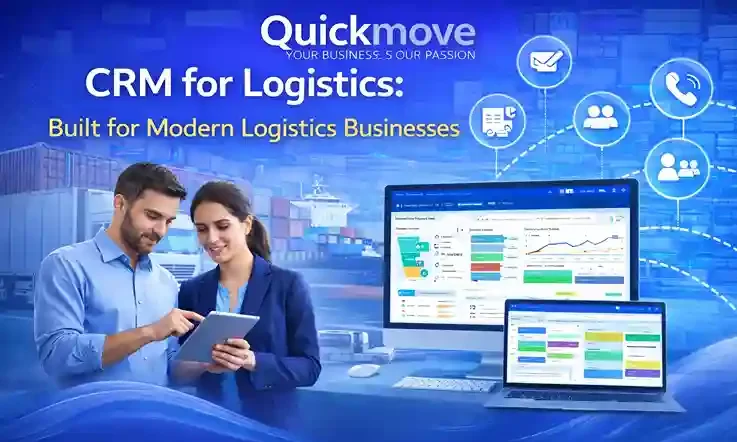
The logistics industry has changed dramatically over the last decade. What was once a back-end support function has now become a customer-facing, experience-driven industry. Today, logistics companies are not just moving goods from point A to point B. They are expected to provide real-time updates, transparent pricing, fast resolutions, personalized service, and consistent communication across every touchpoint.
This is where CRM for logistics becomes a game changer.
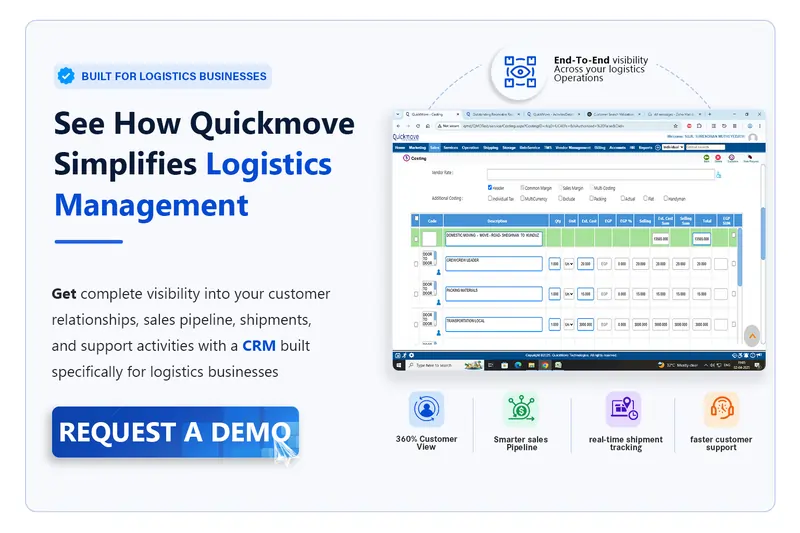
A Customer Relationship Management (CRM) system designed specifically for logistics helps companies manage customers, shipments, sales pipelines, operations, and support—all in one place. It brings structure to chaos, clarity to complexity, and consistency to customer interactions.
Logistics businesses have unique challenges that generic CRMs simply cannot solve. That’s why Quickmove’s logistics CRM is built from the ground up with logistics workflows in mind.
In this blog, we’ll explore:
- What CRM for logistics really means
- Why traditional CRMs fall short
- How Quickmove’s logistics CRM solves real logistics problems
- Key features every logistics CRM should have
- Benefits for sales, operations, and customer service
- Real-world use cases
- How CRM helps you scale sustainably
What Is CRM for Logistics?
CRM for logistics is a specialized system that helps logistics companies manage their relationships with customers, partners, and prospects while connecting those relationships directly to shipments, quotes, invoices, and service activities.
Unlike traditional CRMs that focus mainly on sales contacts and email tracking, a logistics CRM connects customers with cargo, routes, documents, timelines, and service issues.
In short, CRM for logistics helps you:
- Track every customer interaction
- Manage leads and sales opportunities
- Store customer and shipment data centrally
- Automate follow-ups and reminders
- Improve customer service response times
- Gain visibility into your sales and operations pipeline
Quickmove’s CRM takes this concept further by deeply integrating CRM with logistics execution.
Why Logistics Companies Need a Dedicated CRM
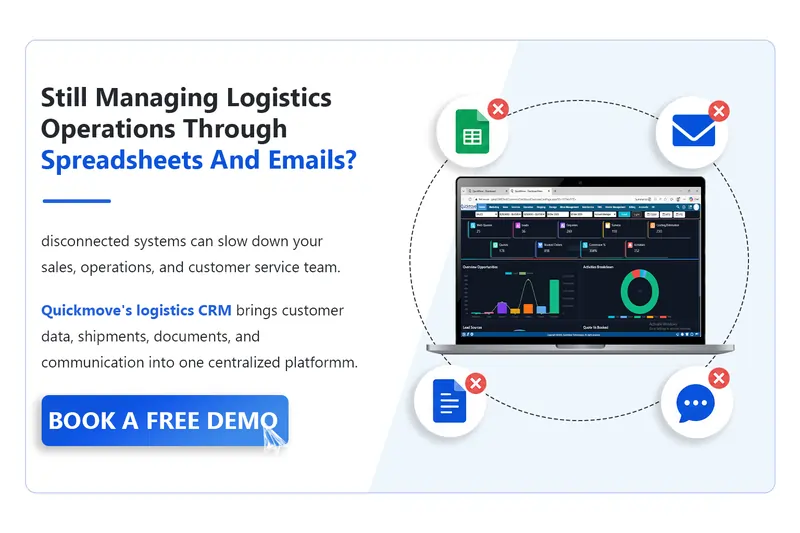
Many logistics companies still rely on spreadsheets, emails, WhatsApp messages, and disconnected tools to manage customers and shipments. While this may work at a small scale, it quickly becomes unmanageable as the business grows.
Common Challenges Without a Logistics CRM
Here are some real problems logistics teams face every day:
- Customer data scattered across emails and spreadsheets
- No single view of customer history or shipments
- Sales teams missing follow-ups and losing leads
- Operations teams struggling to coordinate with sales
- Customer service lacking shipment context
- No clear visibility into revenue pipelines
- Manual reporting that takes hours or days
Without a proper CRM for logistics, teams spend more time searching for information than actually serving customers.
Why Generic CRMs Don’t Work Well for Logistics
Many logistics businesses try to use popular generic CRMs. While these tools are powerful, they are not built for logistics-specific needs.
Limitations of Generic CRMs
- No native shipment or load tracking
- No support for logistics documents
- No route, carrier, or consignment linking
- Heavy customization required
- High implementation and maintenance costs
- Poor alignment between sales and operations
As a result, teams end up using multiple tools alongside the CRM, which defeats the purpose of having a “single source of truth.”
Quickmove eliminates this problem by combining CRM and logistics operations into one unified platform.
Introducing Quickmove’s CRM for Logistics

Quickmove is designed specifically for logistics companies, freight forwarders, transporters, and supply chain businesses.
It goes beyond traditional CRM by connecting:
- Customers
- Sales pipelines
- Shipments
- Documents
- Invoices
- Support tickets
All in one platform.
Quickmove’s CRM is not just software—it’s a logistics relationship engine.
Core Features of Quickmove’s CRM for Logistics
Let’s break down the most important features that make Quickmove a powerful solution for logistics businesses.
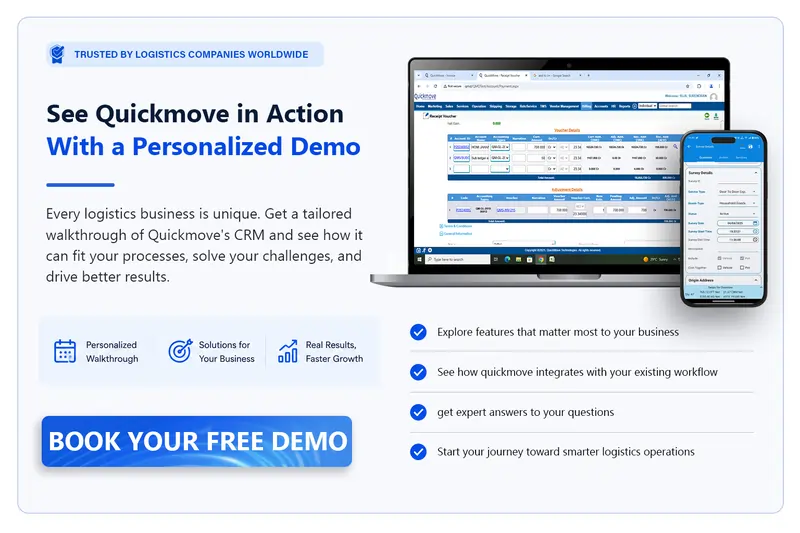
1. Centralized Customer Management
Quickmove gives you a complete 360-degree view of every customer.
You can easily see:
- Contact details
- Company information
- Past and active shipments
- Quotes and contracts
- Invoices and payments
- Support requests
- Communication history
This means no more guessing, no more searching through emails, and no more dependency on individual employees for customer knowledge.
2. Logistics-Focused Sales Pipeline
Sales in logistics is very different from sales in other industries. Deals often involve multiple variables like routes, cargo types, timelines, and pricing negotiations.
Quickmove allows you to:
- Capture leads from multiple sources
- Qualify prospects efficiently
- Create logistics-specific quotes
- Track deal stages clearly
- Forecast revenue accurately
Sales teams can focus on closing deals instead of managing spreadsheets.
3. Seamless Quote-to-Shipment Flow
One of the biggest advantages of Quickmove’s CRM is the seamless transition from sales to operations.
Once a deal is closed:
- The shipment details flow automatically
- Operations teams get full context
- No re-entry of data is required
- Errors and delays are reduced
This alignment between sales and operations is critical for logistics success.
4. Shipment Visibility and Tracking
Quickmove links customers directly to their shipments.
Teams can:
- Track shipment status in real time
- View milestones and timelines
- Identify delays early
- Communicate proactively with customers
This improves transparency and builds trust with customers.
5. Integrated Customer Support
Customer service in logistics is time-sensitive and context-heavy.
Quickmove provides:
- Ticket management linked to shipments
- Complete customer and shipment history
- Faster issue resolution
- Better service consistency
Support teams no longer have to ask customers for basic information—they already have it.
6. Document Management Made Easy
Logistics involves a large number of documents:
- Bills of lading
- Invoices
- Contracts
- Delivery proofs
- Compliance documents
Quickmove allows you to store, organize, and access all documents directly from customer and shipment records.
7. Automated Follow-Ups and Reminders
Missed follow-ups cost logistics companies real money.
With Quickmove’s CRM software for logistics, you can:
- Automate follow-up reminders
- Schedule calls and emails
- Set task alerts for teams
This ensures no lead or customer request falls through the cracks.
8. Real-Time Reports and Analytics
Quickmove’s logistics CRM software provides actionable insights such as:
- Sales pipeline health
- Customer acquisition trends
- Shipment performance
- Revenue forecasts
- Team productivity
Data-driven decisions become easy and fast.
Benefits of CRM for Logistics with Quickmove
Now let’s look at how these features translate into real business benefits.
Improved Customer Experience
With complete visibility and faster response times, customers feel valued and informed. This leads to higher satisfaction and long-term loyalty.
Higher Sales Conversion Rates
Sales teams work smarter with better lead tracking, timely follow-ups, and clear pipeline visibility.
Better Operational Efficiency
By eliminating duplicate data entry and manual coordination, teams save time and reduce errors.
Stronger Team Collaboration
Sales, operations, and support teams work from the same system, improving communication and accountability.
Scalable Growth
Quickmove’s CRM for logistics grows with your business—whether you handle 50 shipments a month or 5,000.
Real-World Use Cases of CRM for Logistics
Freight Forwarders
- Manage international clients
- Track multi-leg shipments
- Handle complex documentation
Transport & Fleet Operators
- Manage shippers and consignees
- Coordinate dispatch and delivery
- Track customer service requests
Warehouses
- Manage multiple clients
- Integrate warehousing and transport
- Provide real-time updates
Moving Companies
- Manage residential and corporate relocation clients
- Track move inquiries, surveys, and quotes
- Coordinate packing, loading, transport, and delivery
How Quickmove’s CRM Helps You Scale Your Logistics Business
Scaling logistics is not just about adding more trucks or routes. It’s about building systems that can handle growth without breaking.
Quickmove’s CRM for logistics industry provides:
- Standardized processes
- Clear accountability
- Reliable data
- Consistent customer experience
This makes growth sustainable and predictable.
Getting Started with Quickmove’s CRM for Logistics
Implementing Quickmove’s CRM is simple:
- Understand your workflows
- Configure CRM to your needs
- Train your teams
- Go live and optimize
The Quickmove team supports you at every step.
From Reactive Service to Proactive Customer Management
Many logistics companies operate in reactive mode—responding to delays, chasing documents, and following up only when customers reach out. While this may keep operations running, it does not build strong, long-term relationships.
Proactive customer management is different. It means sending shipment updates before clients ask, following up on quotes on time, identifying potential delays early, and resolving issues with full context. Instead of constantly firefighting, teams stay one step ahead.
A dedicated logistics CRM makes this possible by centralizing customer, shipment, and communication data in one place. With better visibility and automated reminders, teams can act early, respond faster, and deliver a more consistent customer experience.
The Future of CRM for Logistics
The logistics industry is becoming more competitive, more digital, and more customer-centric.
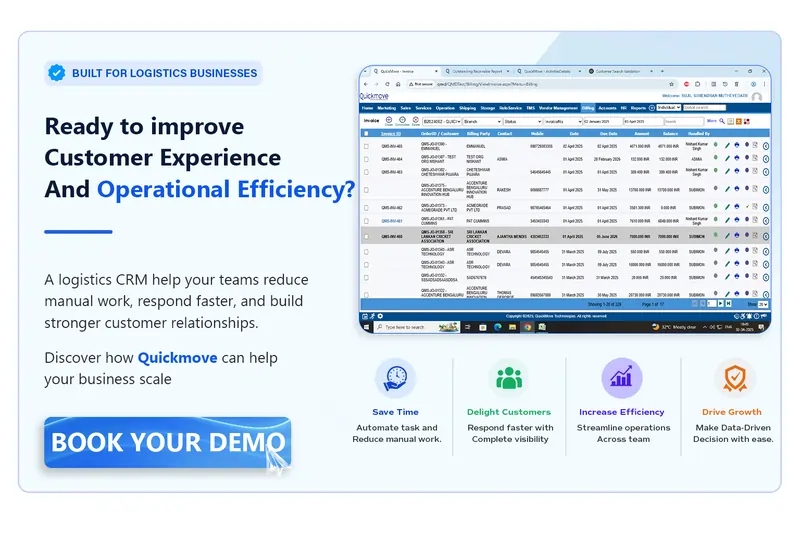
A dedicated CRM for logistics is no longer optional—it’s essential.
Quickmove’s CRM for logistics companies empowers logistics companies to:
- Build stronger customer relationships
- Improve efficiency
- Increase profitability
- Scale with confidence
If you’re ready to move beyond spreadsheets and disconnected tools, Quickmove’s logistics CRM is the right solution for your logistics business.