Email Us
 Freight Forwarding Software
 Warehouse Management System
 Transport Management System
 Moving/Removal Software
 Customer Service Portal
 Move Survey Quote Pro
 Digital Logistics Inventory App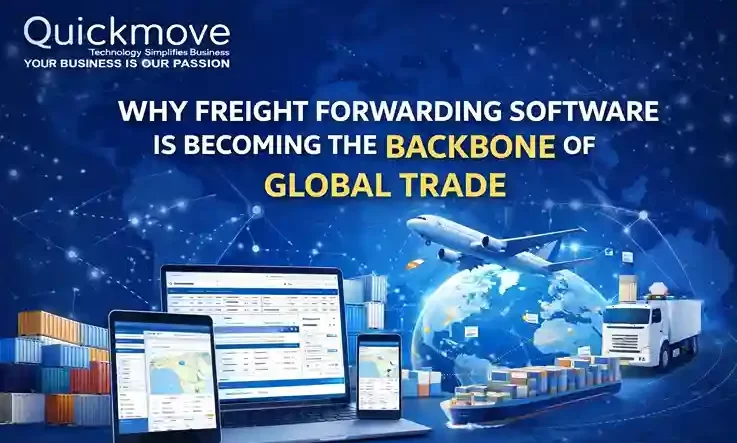
Global trade looks simple from the outside. A product is made in one country, shipped across borders, and delivered to a customer somewhere else. But anyone who has worked in logistics knows the truth: moving goods across the world is one of the most complex operations in modern business.
Behind every international shipment is a long chain of people, documents, regulations, timelines, and decisions. Freight forwarders sit right in the middle of this chain. They coordinate carriers, customs brokers, warehouses, ports, airlines, truckers, and customers—often across different time zones and languages.
For decades, this work was managed using emails, phone calls, spreadsheets, and manual paperwork. That approach worked when volumes were low and trade lanes were predictable. Today, it no longer does.
Global trade has grown faster, more regulated, more customer-driven, and more unpredictable. To keep up, freight forwarders are increasingly relying on freight forwarding software. What used to be “nice to have” technology has now become the backbone of global trade operations.
This article explains why that shift is happening, what is driving it, and how freight forwarding software is quietly reshaping how the world moves goods.
Global Trade Has Outgrown Manual Systems
To understand why freight software has become so critical, we first need to understand how much global trade has changed.
Trade Volumes Are Higher Than Ever
International trade has expanded massively over the last two decades. E-commerce, global sourcing, and just-in-time manufacturing have increased the number of shipments moving across borders every single day.
More shipments mean:
- More bookings
- More documents
- More invoices
- More exceptions
- More customer queries
Trying to manage this scale manually creates bottlenecks very quickly.
Trade Is More Complex, Not Simpler
Trade routes today are not linear. A single shipment might involve:
- Multiple carriers
- Transshipment ports
- Different customs rules
- Mode changes (ocean → rail → road)
Each step generates data and requires coordination. Without a centralized system, information gets scattered—and mistakes follow.
Customers Expect Transparency
Shippers today expect the same visibility they get from parcel delivery apps. They want:
- Real-time tracking
- Accurate ETAs
- Instant updates on delays
- Clear documentation
Manual processes simply cannot deliver this level of transparency consistently.
Freight Forwarders Are the Real Connectors of Global Trade
Freight forwarders are often described as middlemen, but that term doesn’t do justice to their role.
A freight forwarder:
- Plans the shipment route
- Negotiates rates
- Manages bookings
- Handles customs documentation
- Coordinates multiple partners
- Communicates with customers
- Solves problems when things go wrong
They are the orchestrators of global logistics.
As global trade grows more interconnected, the forwarder’s job becomes less about paperwork and more about information management. This is exactly where freight forwarding software comes in.
What Freight Forwarding Software Really Does
At its core, freight forwarding software is a central operating system for a forwarder’s business.
It brings together everything that was previously scattered across emails, spreadsheets, and separate tools into one connected platform.
A Single Source of Truth
Instead of searching through inboxes or Excel files, teams can see:
- Shipment status
- Documents
- Costs and revenues
- Customer communication
- Compliance information
All in one place.
This alone reduces errors and saves countless hours.
Process Standardization
Every forwarder has experienced this problem:
We know how to do this shipment—but only because that one person knows.
Freight forwarding software helps standardize workflows so processes are not dependent on individual memory. This makes operations:
- More consistent
- Easier to train
- Less risky
Automation of Repetitive Work
Many daily tasks in forwarding are repetitive:
- Creating documents
- Sending shipment updates
- Generating invoices
- Matching costs
Software automates these tasks, freeing teams to focus on exceptions and customer service instead of data entry.
Why Software Is Now the Backbone (Not Just a Tool)
Calling freight software, a tool understates its importance today. For many forwarders, it has become the foundation that holds everything together.
Here’s why.
1. Global Trade Runs on Data
Every shipment produces data:
- Locations
- Dates
- Costs
- Customs details
- Performance metrics
Without software, this data is fragmented and underused. With software, it becomes actionable.
Forwarders can:
- Identify delays early
- Track profitability per shipment
- Improve routing decisions
- Provide accurate customer updates
In modern trade, data is as important as physical movement.
2. Compliance Is No Longer Optional
Customs regulations, trade agreements, sanctions, and security requirements keep changing. One mistake can lead to:
- Fines
- Shipment delays
- Customer disputes
- Loss of trust
Freight forwarding software helps by:
- Standardizing documentation
- Reducing manual errors
- Keeping records organized
- Supporting audit readiness
This is especially important for forwarders handling multiple countries and trade lanes.
3. Visibility Has Become a Competitive Advantage
Forwarders used to compete mainly on price and relationships. Today, visibility is just as important.
Customers want to know:
- Where their shipment is
- What’s causing a delay
- When it will arrive
Software enables proactive communication instead of reactive firefighting.
This shift alone has changed how forwarders retain customers.
4. Operations Must Scale Without Chaos
Growth is a good problem—but only if systems can handle it.
Many forwarding companies reach a point where:
- More shipments create more errors
- More customers create more pressure
- More staff doesn’t fix inefficiencies
Freight forwarding software allows businesses to scale processes, not just headcount.
The Role of Software During Disruptions
The last few years have shown how fragile global trade can be.
Port congestion, container shortages, geopolitical conflicts, and weather disruptions have become common. In such conditions, manual systems collapse quickly.
Forwarders using freight forwarding software can:
- Re-route shipments faster
- Communicate delays clearly
- Track alternative options
- Maintain service levels under pressure
This resilience is one of the strongest reasons software has become central to global trade operations.
How Freight Forwarding Software Changes Day-to-Day Work
To really understand the impact, it helps to look at daily operations.
Before Software
- Shipment details scattered across emails
- Manual document creation
- Delayed invoicing
- Constant follow-ups
- Limited visibility
Work depends heavily on individual experience.
After Software
- Centralized shipment dashboard
- Automated documentation
- Faster billing cycles
- Real-time tracking
- Structured workflows
The work becomes more predictable, measurable, and manageable.
This operational clarity is why many experienced forwarders now say they cannot imagine running without software.
Where Quickmove Fits into This Changing Landscape
Different forwarders have different needs. Some focus on regional trade, others on global lanes. Some manage high volumes, others handle specialized cargo.
Quickmove’s freight forwarding software is designed with real forwarding operations in mind, not just technology theory. It supports end-to-end shipment management, visibility, and process control without overcomplicating daily work.
What many users appreciate is that Quickmove focuses on practical usability—helping teams work better, not just adding features for the sake of it.
In an industry where time pressure is constant, software that feels intuitive can make a real difference.
Software Is Also Reshaping the Role of Freight Forwarders
There’s a common fear that software will replace freight forwarders. In reality, the opposite is happening.
Software is:
- Removing low-value manual work
- Supporting faster decision-making
- Enabling better customer service
This allows forwarders to focus on:
- Advisory roles
- Problem solving
- Relationship management
In other words, software strengthens the human side of forwarding instead of replacing it.
Why Smaller Forwarders Need Software Just as Much
There’s a misconception that freight forwarding software is only for large companies.
In practice, smaller and mid-sized forwarders often benefit the most because:
- They have fewer resources
- Mistakes hurt more
- Growth needs structure
Using software early helps them build strong operational foundations instead of fixing problems later.
This is another reason platforms like Quickmove’s freight forwarding software are gaining attention across different business sizes.
The Cost of Not Adopting Freight Forwarding Software
Sometimes the best way to understand value is to look at the cost of inaction.
Forwarders who delay software adoption often face:
- Revenue leakage due to missed charges
- Customer churn from poor visibility
- Operational burnout
- Compliance risks
These costs are rarely visible on a balance sheet—but they accumulate over time.
Freight Forwarding Software and the Future of Global Trade
Looking ahead, global trade will not become simpler.
We can expect:
- More regulations
- Higher customer expectations
- Greater competition
- Faster decision cycles
Freight forwarding software will continue to evolve, but its role as the operational backbone is already clear.
Forwarders who embrace this shift position themselves for long-term relevance.
Those who don’t risk falling behind—not because they lack expertise, but because they lack the systems to support it.
Final Thoughts
Global trade depends on coordination, trust, and speed. Freight forwarders have always delivered these through experience and relationships. Today, they also need technology that matches the scale and complexity of the world they operate in.
Software for freight forwarding companies is no longer just about efficiency. It is about stability, visibility, and growth.
Platforms like Quickmove’s freight forwarding software show how technology can support real-world logistics challenges without losing sight of practical needs.
As global trade continues to evolve, one thing is clear:
the backbone is no longer paper and emails—it’s software.