Email Us
 Freight Forwarding Software
 Warehouse Management System
 Transport Management System
 Moving/Removal Software
 Service Portal
 Move Survey Quote Pro
 Digital Logistics Inventory App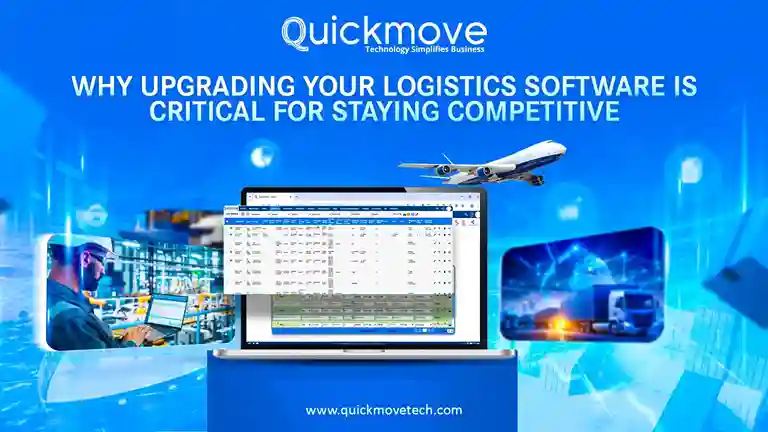
Let’s be honest: logistics isn’t getting simpler. Customers expect faster delivery, real-time updates, fewer mistakes, and better prices — all at once. Meanwhile, fuel costs swing, shipping lanes shift, ports get congested, and last-mile delivery keeps raising the bar.
If your business is still running on older logistics software (or worse, spreadsheets and WhatsApp threads), you’re playing a tough game with one hand tied behind your back. Upgrading isn’t just a tech decision anymore — it’s a business survival move.
Here, we will discuss why upgrading your logistics software is vital for thriving in the competitive logistics industry.
Why Upgrading Logistics Software is Crucial for Staying Competitive
Upgrading your logistics software is one of the most effective ways to stay competitive in a fast-moving industry. Here’s why:
1. Logistics Has Changed — and Old Systems Can’t Keep Up
A few years ago, a decent setup to manage shipments, inventory, and transport was enough. Today? The pace is wild. Think about how often you deal with:
- unexpected ETAs and delivery delays
- rising customer questions about tracking
- more complex multi-stop routes
- tighter SLAs from clients
- messy handoffs between warehouse, fleet, and forwarding teams
Older systems weren’t built for today’s volume or complexity. They buckle under pressure — and the cracks show up as missed deadlines, lost cargo visibility, idle trucks, or stockouts.
Upgraded logistics software helps you handle modern operations without chaos.
2. Manual Work Is Quietly Killing Your Margins
If your team spends hours every day on repetitive tasks like:
- entering shipment details
- updating consignment status
- checking inventory levels
- coordinating with drivers
- preparing documentation
- reconciling bills
…you’re paying for work that software should be doing in the background.
Manual operations don’t just waste time — they create errors. One wrong digit in a BL (Bill of Lading) or packing list, one missed gate-in update, or one mismatched GRN (Goods Receipt Note) can lead to expensive delays and unhappy customers.
Upgrading your logistics software reduces that preventable margin leakage.
3. Customers Expect Visibility, Not Excuses
Whether you’re a freight forwarder, a warehouse operator, a transporter, or a moving company, your customers want clarity. They don’t want to hear:
We’ll check and get back to you.
They want:
- where the shipment is
- when it will reach
- what’s causing a delay (if any)
- what happens next
Modern logistics software supports better shipment visibility, structured updates, and smoother communication across the chain — from origin pickup to final delivery.
That kind of experience is now a competitive advantage.
4. Better Decisions Need Better Data
In logistics, speed matters — but smart speed matters more.
Without a modern system, it’s hard to answer questions like:
- Which lanes are most profitable?
- Which customers create the most rework?
- Are we utilizing warehouse space efficiently?
- Which vehicles are running empty too often?
- What’s our true cost per delivery?
Upgraded logistics software gives you cleaner data and clearer trends, so decisions aren’t based on guesses or gut feel.
5. Your Competitors Are Upgrading
This one stings, but it’s true.
Someone else in your market is already improving turnaround time, trimming errors, and giving customers smoother service — because they’re using newer tools.
And once customers get used to that level of service, they don’t like going back.
Upgrading helps you stay in the race — and in many cases, pull ahead.
6. It Connects the Whole Operation Instead of Creating Silos
One of the biggest problems in logistics businesses is disconnected teams.
Forwarding handles bookings.
Transport handles fleet and routes.
Warehouse handles stock and dispatch.
Accounts handles billing.
Everyone uses different tools.
So information gets stuck in silos, and the customer sits in the middle waiting.
Modern logistics software connects these moving pieces. When your system speaks one language, your business moves faster.
That’s where purpose-built solutions matter — like QuickMove Technologies’ ecosystem for freight forwarding, warehouse management, transport management, and moving operations.
7. You Can Scale Without Adding More Headcount
If growth means hiring 5 more coordinators and 2 more supervisors just to manage volume, that’s not real scalability — that’s stress scaling.
Upgraded logistics software lets you handle more shipments, pickups, put-aways, dispatches, and moves without ballooning your team.
You grow with control, not chaos.
8. Compliance, Documentation, and Audit Readiness Are Getting Tougher
Logistics is not just about moving goods anymore — it’s about moving them correctly.
Customs regulations change. E-way bills expire. Tax structures evolve. Carrier documentation requirements shift. Clients demand clearer billing breakdowns. And audits are becoming more frequent and more detailed.
If your current logistics software doesn’t properly manage documentation, approvals, and record-keeping, you’re exposed to risk.
Think about how many documents flow through your operations every week:
- Bills of Lading
- Delivery Orders
- Invoices
- GRNs (Goods Receipt Notes)
- Proof of Delivery (POD)
- Customs declarations
- Rate confirmations
- Gate-in and gate-out records
When these are handled manually or stored across emails and folders, it becomes difficult to:
- Retrieve documents quickly
- Prove compliance during audits
- Resolve disputes with customers or vendors
- Track version changes
- Avoid duplication or outdated files
Modern logistics software centralizes documentation, timestamps actions, and creates traceable workflows. That means fewer compliance headaches, faster dispute resolution, and stronger credibility with customers and partners.
In a competitive market, trust matters. And nothing builds trust like being organized, transparent, and audit-ready at all times.
Where the Right Software Fits In
Different logistics businesses face different pressure points. You need tools made for your actual work.
If you’re a freight forwarder
You’re juggling rates, carrier coordination, customs clearance, containers, and constant schedule shifts. A freight forwarding software like QuickMove’s helps keep operations organized and responsive without drowning your team.
If you handle warehousing
Inventory accuracy, space usage, and faster dispatch matter. With a reliable warehouse management system, you can tighten control over bins, stock movement, inbound/outbound, and order fulfillment.
If you manage transport
You deal with fleet utilization, route planning, driver coordination, and delivery proof. A transport management system helps you stay on top of the daily grind and keep vehicles productive.
If you run a moving business
Your work includes survey, packing, loading, transit, and final unloading, often under tight customer timelines. Moving software built for removals can make those jobs smoother for both teams and customers.
QuickMove Technologies offers software across these four areas, built around real operational needs — not just dashboards.
What Upgrading Really Means (It’s Not Just Buying New Tech)
Upgrading your logistics management software is about fixing friction points that slow you down every day. It’s about:
- fewer follow-ups
- clearer ownership
- faster handovers
- cleaner billing
- stronger customer trust
- better control over your business
It’s not about fancy buzzwords. It’s about making your operations feel lighter without reducing quality.
The Hidden Cost of We’ve Always Done It This Way
A lot of logistics companies delay upgrades for a simple reason: the current system still works. Orders go out, trucks move, warehouses dispatch, containers clear.
But “still works” can be the most expensive situation of all.
Here’s what quietly happens when a business sticks to old logistics software:
- People create their own “workarounds” (usually spreadsheets).
- Knowledge gets locked inside a few experienced staff members.
- Daily ops become dependent on memory, not process.
- Errors feel normal because they happen every week.
- Management sees results late, so decisions are always reactive.
This is how businesses slowly bleed efficiency. Nobody sees a big crash — just a long, silent leak.
Upgrading doesn’t mean your team forgot how logistics works. It means the systems finally support how your team already works.
To put it simply: logistics is a high-tempo, exception-heavy industry. Your team handles real-world surprises every day — customs holds, route diversions, damaged cartons, no-show trucks, rain delays, port congestion, labor shortages. When your software is outdated, it forces people to spend energy on basic coordination instead of solving real exceptions.
That’s the hidden tax of old systems.
Real-World Signs You’re Due for an Upgrade
If you’re in the middle of operations every day, it’s sometimes hard to step back and call it out. So here are practical “red flags” that tell you your logistics software is holding you back:
- You rely on calls to know shipment status.
If your staff has to ring drivers or agents to confirm updates, visibility is too weak. - Your warehouse accuracy depends on one or two people.
When only a supervisor knows which rack has what stock, the system isn’t doing its job. - You keep re-entering the same data.
If booking details, dispatch info, and billing all need separate entries, your workflow is fragmented. - Customer updates are delayed or inconsistent.
If clients ask for PODs, ETAs, or container movement more than once, you’re losing trust. - Reports take days to compile.
Modern operations need daily or even live data for load planning, inventory turns, and delivery performance. - Scaling feels scary.
When growth equals stress instead of excitement, tools aren’t scaling with you.
If two or more of these feel familiar, upgrading your logistics software will probably pay for itself faster than you think.
Another subtle sign: your team spends more time explaining what happened than preventing it from happening. That’s usually a systems issue, not a people issue.
Final Thought
Logistics businesses don’t win by being the biggest. They win by being the fastest, sharpest, and most reliable.
Upgrading your logistics software is one of the clearest ways to protect your margins, keep customers happy, and stay competitive in a market that won’t wait.
If you’re considering a move, QuickMove Technologies’ logistics software is worth a look — especially if you want tools that match how logistics really works on the ground.
Because in this industry, staying still is the quickest way to fall behind.