Email Us

 Freight Forwarding Software
 Warehouse Management System
 Transport Management System
 Moving/Removal Software
 Customer Service Portal
 Move Survey Quote Pro
 Digital Logistics Inventory App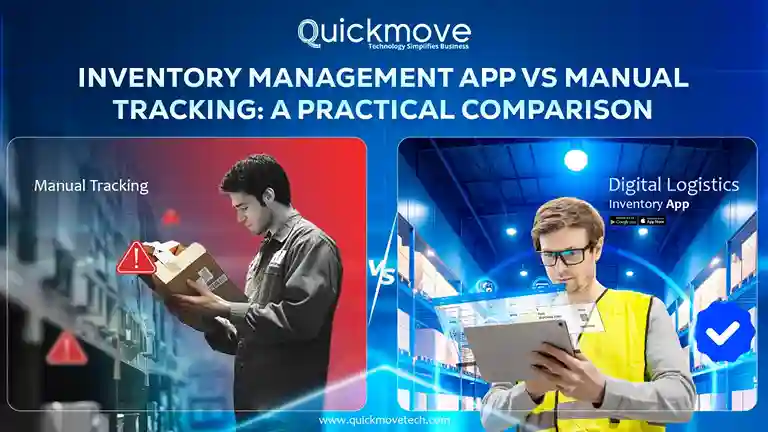
Managing inventory sounds simple on the surface. You buy stock, store it, and sell or use it when needed. But anyone who has handled inventory in a real business knows it’s rarely that straightforward. Numbers don’t match. Items go missing. Stock runs out at the worst possible time. And sometimes, there’s too much inventory sitting idle, tying up cash.
For years, businesses relied on notebooks, spreadsheets, and manual registers to track inventory. This method worked when operations were small and manageable. But as businesses grew, manual tracking started creating more problems than solutions.
Today, many companies are moving toward using an inventory management app to simplify operations, reduce mistakes, and gain real-time control over their stock.
In this detailed guide, we’ll take a look at manual tracking versus using an inventory management app.
Understanding Inventory Management in Simple Terms
Inventory management means keeping track of what stock you have, where it is stored, how much is coming in, and how much is going out.
It applies to:
- Warehouses
- Retail stores
- Manufacturing units
- Logistics companies
- Moving and storage businesses
- Distributors and wholesalers
Good inventory management ensures:
- You never run out of important items
- You don’t overstock unnecessarily
- You know exactly what you have at any time
- You avoid losses due to damage or theft
The method you use to manage inventory plays a big role in how smooth your operations run.
What is Manual Inventory Tracking?
Manual tracking means recording inventory details without using dedicated software. Common methods include:
- Writing in registers
- Maintaining stock cards
- Using Excel or Google Sheets
- Updating data at the end of the day
Many small businesses start with this method because it’s easy and inexpensive.
At first, it feels manageable.
You know where things are. You remember what was sold. You trust your team to keep records updated.
But as the business grows, manual tracking slowly becomes harder to control.
What is an Inventory Management App?
An inventory management app is a digital tool that helps you track stock automatically and in real time. Instead of writing things down, you enter or scan items, and the system updates inventory instantly.
With an inventory management app, businesses can:
- Track stock levels live
- Monitor movement across locations
- Get alerts when stock is low
- Generate reports instantly
- Reduce human errors
Solutions like QuickMove’s inventory management app are designed specifically for operational businesses that handle physical goods daily and need accurate visibility without spending hours updating records.
Why This Comparison Matters
Choosing between manual tracking and an inventory management app is not just about technology. It’s about:
- Saving time
- Preventing costly mistakes
- Improving decision-making
- Supporting business growth
The wrong system can slow down your operations. The right one can make work easier for everyone.
Let’s compare both approaches in a practical way.
1) Accuracy: Human Memory vs System-Based Tracking
Manual Tracking
Manual tracking depends heavily on people.
Someone has to:
- Write down incoming stock
- Update outgoing stock
- Correct mistakes
- Double-check entries
Even the most careful team can make errors. A single wrong entry can create confusion later.
Common problems include:
- Missed updates
- Duplicate entries
- Incorrect counts
- Lost paperwork
And these mistakes don’t show up immediately. They usually appear when stock is needed urgently.
Inventory Management App
An inventory management app reduces dependency on memory and manual entries.
Stock gets updated when:
- Items are scanned
- Orders are processed
- Goods are moved
This creates a more reliable system. Businesses using tools like QuickMove’s inventory management app often notice that inventory mismatches reduce significantly because updates happen as part of daily workflows, not later.
2) Time Investment: Slow Updates vs Instant Visibility
Manual Tracking
Manual tracking takes time every single day.
- Writing entries
- Updating spreadsheets
- Counting stock
- Verifying numbers
As inventory grows, the time required also increases.
What starts as 10 minutes a day can turn into hours every week.
Inventory Management App
With an app for inventory management, updates happen instantly.
There is no need to:
- Re-enter data multiple times
- Maintain separate records
- Search for old information
The system keeps everything organized automatically.
This frees up time for more important work like customer service, planning, and growth.
3) Stock Visibility: Guesswork vs Real-Time Data
Manual Tracking
Manual systems often answer inventory questions like:
- “We think we have enough.”
- “Let me check and get back to you.”
- “It should be in the warehouse.”
This creates uncertainty.
Teams spend time searching, counting, and confirming.
Inventory Management App
An inventory management app shows exactly:
- What is in stock
- What is low
- What is reserved
- What is incoming
This real-time visibility helps businesses plan better.
QuickMove’s inventory management app, for example, gives a clear view of stock movement so teams can make faster decisions without waiting for manual verification.
4) Scalability: Small Business vs Growing Business Needs
Manual Tracking
Manual tracking works best when:
- Inventory is small
- Transactions are limited
- Teams are small
But growth creates pressure.
More products mean:
- More entries
- More errors
- More confusion
Eventually, manual systems start slowing everything down.
Inventory Management App
An inventory management app grows with your business.
Whether you manage:
- One location
- Multiple warehouses
- Large product catalogs
The system can handle increased complexity without increasing workload.
This makes it easier to expand operations without losing control.
5) Cost Comparison: Saving Money vs Losing Money
Manual Tracking
At first, manual tracking looks cheaper.
You don’t pay for software.
But there are hidden costs:
- Wasted time
- Stock losses
- Overstocking
- Emergency purchases
- Customer dissatisfaction
These costs add up over time.
Inventory Management App
An inventory management mobile app involves a software investment.
But it helps save money by:
- Reducing stock mistakes
- Preventing over-purchasing
- Avoiding stockouts
- Improving planning
Businesses using QuickMove’s inventory management app often find that better visibility leads to smarter purchasing decisions and less financial waste.
6) Decision Making: Delayed Insights vs Instant Reports
Manual Tracking
Getting insights from manual records takes effort.
You need to:
- Compile data
- Check numbers
- Build reports manually
This means decisions are often based on outdated information.
Inventory Management App
An inventory management app can generate reports instantly.
You can see:
- Fast-moving items
- Slow-moving stock
- Stock value
- Usage patterns
This helps leaders make smarter business decisions quickly.
7) Error Handling: Difficult to Trace vs Easy to Identify
Manual Tracking
When something goes wrong, finding the problem is hard.
You have to:
- Check past entries
- Recount stock
- Ask multiple people
It can take hours to find where things went off track.
Inventory Management App
An inventory management app keeps a clear record of every movement.
You can track:
- Who updated stock
- When it was updated
- What changes were made
This makes it easier to identify and fix mistakes quickly.
8) Team Productivity: Repetitive Work vs Smart Workflows
Manual Tracking
Teams spend time on repetitive tasks like:
- Writing
- Updating sheets
- Double-checking counts
This reduces productivity.
People end up doing record-keeping instead of meaningful work.
Inventory Management App
With an inventory management app, many tasks become simpler.
Staff can focus on:
- Handling operations
- Improving service
- Managing deliveries
Tools like QuickMove’s inventory management mobile app help reduce routine paperwork and make daily work smoother.
9) Customer Experience: Delays vs Confidence
Manual Tracking
When inventory is unclear:
- Orders get delayed
- Customers receive wrong information
- Delivery timelines get affected
This hurts trust.
Inventory Management App
An inventory app helps you respond faster.
You can confirm availability instantly and serve customers with confidence.
QuickMove’s inventory management app supports better coordination between teams, which leads to fewer delays and better service.
10) Stress Levels: Constant Checking vs Peace of Mind
Manual Tracking
Manual systems require constant attention.
Managers often worry about:
- Stock mismatches
- Missing items
- Wrong counts
This creates daily stress.
Inventory Management App
An inventory management app gives peace of mind.
You know:
- What’s available
- What’s running low
- What needs restocking
The system keeps things organized so you don’t have to keep everything in your head.
When Manual Tracking Still Makes Sense
To be fair, manual tracking is not always wrong.
It can work if:
- You have very limited inventory
- Transactions are rare
- Operations are simple
- Growth is not a priority
For a small setup, it may be enough for a while.
But the moment complexity increases, problems start appearing.
When It’s Time to Switch
Here are signs that manual tracking is no longer working:
- Frequent stock mismatches
- Spending too much time updating records
- Difficulty finding items
- Overstocking or stockouts
- Confusion across teams
These are strong signals that an inventory management app can make a real difference.
Final Thoughts
There is no single system that fits every business. Manual tracking served businesses well for decades, and in very small setups, it can still work.
But as operations grow, manual methods start showing clear limitations.
An inventory management app offers:
- Better accuracy
- Time savings
- Real-time visibility
- Easier scaling
- Improved decision-making
The goal is not just to track inventory. It’s to create a system that supports your team, reduces stress, and helps the business grow smoothly.
For companies that are ready to move beyond registers and spreadsheets, adopting a structured solution like QuickMove’s inventory management app can be a practical step toward better control and more confident operations.
In the end, inventory management is not just about counting items. It’s about building a reliable foundation for your entire business.