Email Us
 Freight Forwarding Software
 Warehouse Management System
 Transport Management System
 Moving/Removal Software
 Customer Service Portal
 Move Survey Quote Pro
 Digital Logistics Inventory App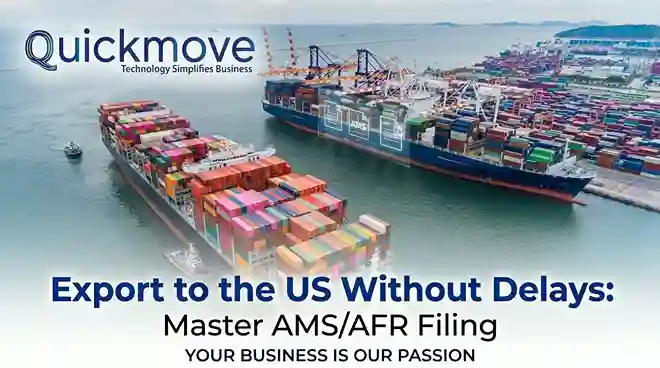
Shipping goods to the United States is not as simple as just sending containers. There are strict rules you must follow.
For logistics companies, freight forwarders, and exporters, submitting AMS (Automated Manifest System) and AFR (Advance Filing Rules) details correctly and on time is very important. If you don’t, your shipment can get delayed, fined, or even rejected.
The problem?
Managing all this across different systems and service providers can get confusing and time-consuming.
In this blog, we’ll explain everything in a simple way and show how modern systems make AMS/AFR filing much easier.
What is AMS/AFR Filing? (Simple Explanation)
Let’s break it down:
- AMS: A system used by U.S. Customs to track cargo coming into the country
- AFR: A rule that says shipment details must be submitted before the cargo is loaded onto the ship
In simple words:
You must share all shipment details before your goods even leave the port.
If you don’t follow this:
- You may face heavy penalties
- Your cargo may be stopped
- Your shipment can get delayed
Common Problems Logistics Companies Face
Many businesses struggle with AMS/AFR filing because:
- They use multiple systems that don’t connect with each other
- Teams manually enter data, which leads to mistakes
- They depend too much on third-party agents
- There is no clear visibility of what’s happening
These issues waste time, increase errors, and affect customer satisfaction.
A Smarter and Easier Way
Modern logistics software solves these problems by making the process simple and automated.
1. Already Have a Service Provider? No Need to Change
If you are already using an AMS/AFR service provider:
The system can connect directly to your provider (if API access is available).
This helps you:
- Keep your existing provider
- Automatically send data without manual work
- Reduce errors
- Submit filings faster
2. No API Available? Still Not a Problem
Sometimes, direct connection (API) is not available.
In that case, the system can create EDI/XML files automatically.
These files can be:
- Uploaded to authorized platforms
- Sent to agents
- Used in government-approved systems
This means:
- You stay compliant with U.S. rules
- No formatting mistakes
- Less manual work
Why This is Important for Your Business
No matter the size of your business, automation helps a lot:
- Better Accuracy: Fewer mistakes in shipment data
- Faster Process: Quick filing means faster shipping
- Stay Compliant: Follow all U.S. rules without stress
- Grow Easily: Handle more shipments without increasing workload
Real-Life Scenario
Let’s say you send shipments to the U.S. every day:
Without automation:
Your team manually prepares documents, contacts agents, and keeps following up.
With automation:
Data flows automatically → files are generated → submissions are done instantly
Result:
Less work, fewer errors, and faster shipments.
Who Can Benefit from This?
This solution is perfect for:
- Freight forwarders
- NVOCC operators
- Export companies
- Logistics service providers
- Supply chain businesses exporting to the U.S.
Final Thoughts
Handling U.S. export rules doesn’t have to be difficult.
With the right system, you can:
- Connect with your existing AMS/AFR provider
- Or generate files automatically when integration is not possible
Either way, your work becomes faster, easier, and more reliable.
In today’s fast-moving logistics world, using smart and simple technology is the key to staying ahead of your competitors.