Email Us
 Freight Forwarding Software
 Warehouse Management System
 Transport Management System
 Moving/Removal Software
 Customer Service Portal
 Move Survey Quote Pro
 Digital Logistics Inventory App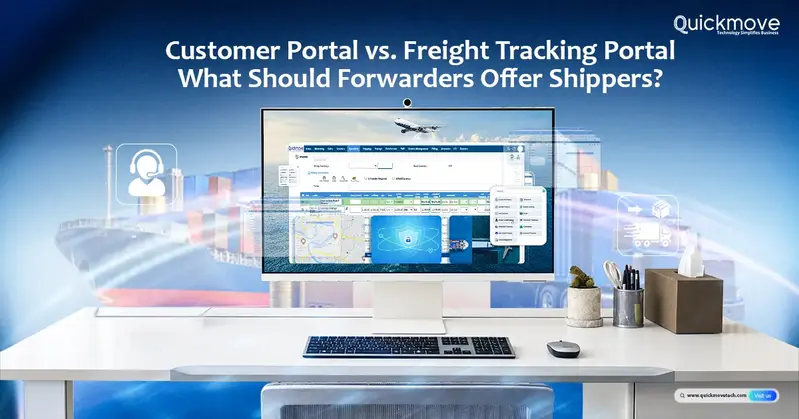
For modern freight forwarders, digital visibility is no longer limited to providing a shipment tracking number. Shippers increasingly expect convenient access to shipment information, documents, communication, billing details, and other services through a centralized digital experience.
This raises an important question for freight forwarding companies: Should you provide a customer portal, a freight tracking portal, or both?
Although the terms are sometimes used interchangeably, a customer portal and a freight tracking portal serve different purposes. A tracking portal primarily helps shippers monitor shipment progress, while a broader customer portal can provide access to multiple services throughout the customer relationship.
For freight forwarders evaluating technology investments, understanding this distinction can help determine which solution aligns with their operational requirements and customer expectations.
What Is a Customer Portal for Freight Forwarders?
A freight forwarding customer portal is a digital platform that allows shippers to interact with their freight forwarder through a centralized online interface
Instead of relying entirely on emails, phone calls, spreadsheets, and separate systems, customers can access relevant information and perform certain activities from one place.
Common Customer Portal Features
Depending on the freight forwarding software being used, a customer portal may provide access to:
- Shipment information
- Booking requests
- Shipment status
- Freight tracking
- Shipping documents
- Commercial invoices
- Quotations
- Billing information
- Delivery information
- Customer communication
- Notifications and alerts
- Reports
- Shipment history
The primary objective is broader than tracking. A customer portal is designed to create a digital communication and service layer between the freight forwarder and the shipper.
Why Customer Portals Matter
For freight forwarders handling a large customer base, repetitive information requests can consume significant operational resources.
Customers may ask:
- Where is my shipment?
- Has the shipment departed?
- When is the expected arrival?
- Is the documentation available?
- Has the delivery been completed?
- Can I download the shipment documents?
- What is the status of my booking?
A centralized customer portal can help customers find relevant information without requiring an employee to respond manually to every routine request.
This can create a more structured customer experience while allowing internal teams to focus on exceptions, complex shipments, and higher-value activities.
What Is a Freight Tracking Portal?
A freight tracking portal is primarily designed to provide shipment visibility.
Its central purpose is straightforward: allow shippers to determine where their freight is, what stage it has reached, and what the current shipment status indicates.
Depending on the system and transportation mode, tracking information may include:
- Booking status
- Pickup status
- Departure information
- Port or terminal milestones
- Vessel or flight information
- Transshipment updates
- Estimated arrival
- Actual arrival
- Customs milestones
- Delivery status
A tracking portal can be particularly useful for customers who mainly need real-time or near-real-time shipment visibility.
The Primary Focus Is Visibility
The fundamental difference is scope.
A freight tracking portal answers the question:
“Where is my shipment and what is its current status?”
A customer portal can address a much broader set of questions:
“How can I manage and interact with my freight forwarding services digitally?”
That distinction becomes important when forwarders are deciding what technology to provide to shippers.
Customer Portal vs. Freight Tracking Portal: Key Differences
Although both solutions can improve customer visibility, they are not identical.
| Area | Customer Portal | Freight Tracking Portal |
| Primary purpose | Customer interaction and service management | Shipment visibility |
| Shipment tracking | Yes | Yes |
| Booking requests | Often available | Usually limited or unavailable |
| Document access | Often available | May be limited |
| Quotations | Can be included | Usually not a core function |
| Billing information | Can be included | Usually not a core function |
| Customer communication | Can be integrated | Generally limited |
| Shipment history | Yes | Yes |
| Reports | Often available | May be limited |
| Customer self-service | Broad | Primarily tracking-focused |
| Scope | End-to-end customer experience | Shipment visibility |
The exact functionality depends on the software provider, but the distinction remains useful: a tracking portal is generally a component of a broader customer portal rather than a complete replacement for one.
What Do Shippers Expect From a Modern Portal?
Shipper expectations have changed as digital services have become standard across many industries.
Customers increasingly expect information to be available without waiting for a response from an account manager or operations team.
For freight forwarders, this means a digital portal should ideally go beyond displaying a shipment status.
1. Centralized Shipment Visibility
Customers should be able to view relevant shipments from a single interface.
Instead of searching through email conversations or spreadsheets, they can access shipment information through a centralized system.
2. Document Accessibility
Shipping involves substantial documentation.
Depending on the shipment and service, customers may need access to:
- Commercial invoices
- Packing lists
- Bills of lading
- Air waybills
- Delivery documents
- Customs-related documents
- Other shipment records
Making relevant documents accessible through a portal can reduce unnecessary email exchanges.
3. Booking Management
A more comprehensive customer portal can allow customers to submit booking requests or access booking information.
This creates an additional digital interaction point between the shipper and forwarder.
4. Notifications and Alerts
Customers may benefit from notifications when important shipment milestones occur.
For example:
- Shipment booked
- Cargo picked up
- Vessel departed
- Flight departed
- Shipment arrived
- Customs milestone updated
- Delivery completed
Automated notifications can reduce the need for customers to repeatedly check shipment status.
5. Historical Information
A customer portal can provide access to previous shipments and related information.
This can be particularly valuable for businesses managing regular international shipments and needing historical data for internal reporting or reconciliation.
Why Freight Tracking Alone May Not Be Enough
Freight tracking is an important part of digital customer service, but tracking by itself may address only one part of the shipper’s requirements.
Consider a shipper that wants to know the status of a shipment and download its related documentation.
If the forwarder provides only a tracking portal, the customer may still need to contact the operations team to obtain documents.
The same applies when customers need information about bookings, quotations, billing, or previous shipments.
This can create a fragmented experience.
A broader customer portal can bring multiple customer-facing functions into a single digital environment.
Tracking Is a Feature; Customer Experience Is the Larger Objective
This is an important distinction for decision-makers.
A freight tracking portal can provide visibility.
A customer portal can potentially combine visibility, communication, documentation, self-service, and customer information in one platform.
Therefore, the decision should not simply be:
“Do we need tracking?”
The more useful question is:
“What parts of the customer journey should we make digitally accessible?”
When a Customer Portal Makes More Business Sense
A broader customer portal may be particularly relevant for freight forwarders that:
- Manage a large number of recurring customers
- Handle high shipment volumes
- Receive frequent status inquiries
- Exchange large volumes of documents
- Want to reduce manual customer-service interactions
- Offer multiple logistics services
- Need centralized customer information
- Want to improve digital customer engagement
For these organizations, tracking may be one component of a wider digital strategy.
When a Freight Tracking Portal May Be Sufficient
A dedicated tracking experience may be appropriate when the primary customer requirement is shipment visibility.
For example, a forwarder may have customers who primarily want to:
- Enter a shipment reference.
- View the current shipment status.
- Review milestone updates.
- Check estimated arrival information.
- Confirm delivery status.
If these are the primary requirements, a focused tracking solution may satisfy the immediate need.
However, forwarders should consider whether customer expectations are likely to expand as more services become digitized.
Should Forwarders Offer Both Portals?
In many cases, the most comprehensive approach is not to treat customer portals and tracking portals as competing solutions.
Instead, tracking functionality can be incorporated into a broader customer portal.
A customer could log into one platform and access:
Dashboard → Bookings → Shipments → Tracking → Documents → Billing → Reports
This creates a more unified digital experience.
A Practical Portal Architecture
A forwarder could structure its customer-facing platform around several layers:
Layer 1: Shipment Visibility
Customers can see shipment milestones, current status, estimated arrival, and delivery information.
Layer 2: Documentation
Customers can access relevant shipment documents from the same environment.
Layer 3: Customer Self-Service
Customers can submit booking requests, review quotations, or initiate other predefined workflows.
Layer 4: Communication
Notifications and relevant customer communications can be connected to shipment events.
Layer 5: Reporting
Customers can review shipment history and generate reports based on their business requirements.
This approach allows freight tracking to become part of a broader customer experience rather than functioning as an isolated tool.
Essential Features to Look for in a Freight Forwarding Customer Portal
When evaluating a customer portal, decision-makers should look beyond the visual interface.
The underlying capabilities can have a significant impact on long-term value.
Shipment Tracking
The portal should provide clear shipment milestones and status information.
Document Management
Customers should be able to access relevant documents without unnecessary manual intervention.
Customer-Specific Access
Different customers may require different levels of access. Role-based permissions can help ensure that users see appropriate information.
Notifications
Automated alerts can help customers stay informed about important shipment events.
Search and Filtering
Customers managing numerous shipments should be able to filter information by factors such as:
- Shipment number
- Customer reference
- Date
- Origin
- Destination
- Mode
- Status
Reporting
Reporting capabilities can help customers analyze their shipment activity and identify trends.
Mobile Accessibility
Customers and logistics professionals may need to access shipment information while away from their desks. A responsive interface can therefore be an important consideration.
Integration With Freight Forwarding Software
A portal becomes more useful when it is connected to the forwarder’s operational systems.
Ideally, customers should not need to wait for employees to manually update portal information.
Integration can help synchronize relevant data between internal operations and the customer-facing interface.
How Portals Can Improve the Shipper Experience
A well-designed portal can influence the customer experience in several practical ways.
Faster Access to Information
Customers can retrieve information directly instead of sending routine status requests.
Greater Transparency
Centralized shipment milestones can give customers clearer visibility into their cargo movement.
Reduced Communication Friction
When common information is available through self-service tools, customers may have fewer reasons to contact operations teams for routine questions.
More Consistent Information
A centralized system can provide customers with information drawn from the forwarder’s operational data rather than relying on manually exchanged spreadsheets or email updates.
Better Scalability
As shipment volumes and customer numbers grow, digital self-service capabilities can help support customer interactions without relying entirely on proportional increases in manual communication.
How Forwarders Can Choose the Right Portal
Before selecting a solution, decision-makers should evaluate their current customer journey.
Start by asking:
What Are Customers Asking Us Most Frequently?
If most requests are shipment-status questions, tracking should be a priority.
If customers frequently request documents, bookings, quotations, reports, and billing information, a broader customer portal may be more appropriate.
How Many Manual Interactions Occur?
Review the volume of emails, phone calls, and messages related to routine shipment information.
This can help identify where digital self-service could provide operational value.
What Systems Are Already in Place?
A portal should fit into the forwarder’s existing technology environment.
Consider integrations with:
- Freight forwarding software
- TMS platforms
- Accounting systems
- Carrier systems
- Customs systems
- Document management systems
- Communication platforms
What Will Customers Need in the Future?
Technology decisions should not be based solely on today’s requirements.
A forwarder should also consider whether the portal can support additional services as customer expectations and business processes evolve.
Customer Portal vs. Freight Tracking Portal: The Strategic Difference
The distinction can be summarized simply.
A freight tracking portal primarily provides shipment visibility.
A customer portal can provide a broader digital relationship between the freight forwarder and the shipper.
Therefore, forwarders should evaluate the two based on the customer journey they want to support.
For companies looking to modernize their digital operations, solutions such as specialized freight forwarding software can provide a foundation for connecting operational processes with customer-facing capabilities.
The objective should not be to add another technology layer simply because competitors have one. Instead, the portal should solve specific customer and operational requirements while fitting into the forwarder’s broader technology strategy.
Final Thoughts
The question of customer portal vs. freight tracking portal is ultimately a question of scope.
A freight tracking portal can give shippers visibility into their cargo movement. A customer portal can extend that experience by bringing together shipment information, documents, bookings, communication, reporting, and other customer-facing services.
For freight forwarders, the right approach depends on customer requirements, shipment volumes, operational processes, existing technology, and long-term digital objectives.
Rather than viewing tracking and customer portals as mutually exclusive, forwarders can consider tracking as one important capability within a broader customer portal.