Email Us
 Freight Forwarding Software
 Warehouse Management System
 Transport Management System
 Moving/Removal Software
 Customer Service Portal
 Move Survey Quote Pro
 Digital Logistics Inventory App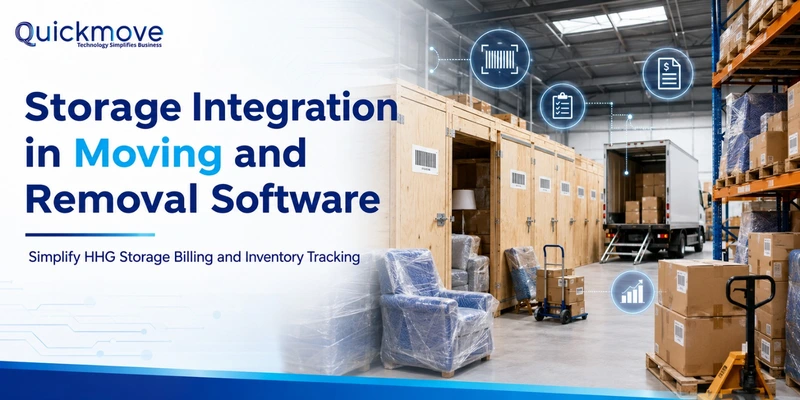
Managing household goods does not always end when a shipment reaches its destination. Customers may require short-term transit storage, long-term warehousing, or temporary storage while waiting for customs clearance, property access, or final delivery.
Without an integrated system, movers often rely on spreadsheets, paper documents, and separate billing applications. This creates billing errors, limited inventory visibility, and delays in locating stored goods. QuickMove Moving and Removal Software brings storage management, billing, inventory tracking, and customer records together on one centralized platform.
What Is Storage Integration in Moving and Removal Software?
Storage integration connects warehouse activities directly with moving operations. Every item entering or leaving storage can be recorded against the relevant customer, move, shipment, container, vault, or storage location.
The system provides a complete operational record covering:
- Customer and shipment information
- Storage type and agreed duration
- Inward and outward movement dates
- Warehouse, zone, rack, vault, or container location
- Storage volume, weight, or unit quantity
- Recurring and one-time storage charges
- Inventory condition and supporting documents
- Partial release and final delivery details
This integration allows moving companies to manage transit and long-term household goods storage without maintaining disconnected records.
Transit Storage Management for Household Goods Shipments
Transit storage is used when household goods must be stored temporarily before continuing to their final destination. This may occur because of delivery scheduling, customs procedures, route planning, property availability, or unexpected transportation delays.
Record Every Transit Storage Movement
QuickMove allows operations teams to connect storage activities with the original move order. When goods arrive at the warehouse, employees can create an inward entry and record important details such as:
- Shipment or job reference number
- Customer name and contact information
- Warehouse arrival date
- Expected outward or delivery date
- Number of packages, pallets, crates, or containers
- Volume and weight of stored goods
- Assigned storage location
- Condition of goods at the time of receipt
- Handling instructions and special requirements
When the shipment leaves storage, an outward entry updates the job and inventory status. This creates an accurate movement history from collection to final delivery.
Improve Visibility During Storage in Transit
Customer service and operations teams can quickly check whether a shipment is awaiting inward processing, currently in storage, partially released, scheduled for dispatch, or completely delivered.
Better visibility helps teams answer customer questions without contacting multiple departments or searching through physical warehouse records.
Long-Term HHG Storage Management
Long-term household goods storage requires more detailed control than temporary storage. A customer’s belongings may remain in a warehouse for several months or years, making accurate location tracking and recurring billing essential.
Organize HHG Inventory by Storage Location
QuickMove Moving and Removal Software helps warehouse teams assign goods to specific storage locations, including:
- Warehouses and branches
- Storage zones
- Racks and shelves
- Vaults and containers
- Pallets, crates, and individual packages
This organized location structure reduces the time required to find a customer’s goods. It also lowers the risk of misplaced inventory and supports more efficient warehouse utilization.
Maintain a Complete Storage History
Every storage activity can be connected to the customer’s move file. Teams can review when goods were received, where they were stored, whether they were moved internally, and when they were released.
A complete storage history is particularly valuable when handling long-term accounts, customer enquiries, damage claims, and inventory audits.
Automated Transit and Long-Term Storage Billing
Manual storage billing becomes difficult when charges vary according to storage duration, volume, weight, warehouse location, or service agreement. Missing a billing period or using an incorrect storage date can directly affect revenue.
Integrated storage billing helps moving companies calculate charges using verified operational information.
Configure Flexible HHG Storage Charges
Depending on the company’s pricing structure, storage charges can be calculated using:
- Daily, weekly, monthly, or quarterly billing cycles
- Shipment volume or weight
- Number of vaults, containers, pallets, or storage units
- Minimum storage periods
- Agreed customer or corporate rates
- Warehouse handling fees
- Inward and outward handling charges
- Packing, unpacking, or repacking services
- Insurance and additional service charges
This flexibility allows movers to manage different residential, corporate, relocation, and international moving contracts from the same system.
Generate Recurring Storage Invoices
For long-term HHG storage, the software can maintain the billing schedule and support recurring invoice generation. Billing teams can review storage periods, applicable rates, outstanding charges, and payment details without manually calculating every invoice.
Automated billing helps businesses:
- Reduce missed storage invoices
- Prevent incorrect billing periods
- Apply agreed rates consistently
- Improve invoice preparation speed
- Maintain transparent customer statements
- Strengthen storage revenue control
Handle Partial Releases Accurately
Customers do not always remove all their goods at once. They may request the release of selected cartons, furniture, appliances, or storage units while leaving the remaining items in the warehouse.
With inward and outward tracking, teams can record partial releases and update the balance of stored goods. Future billing can then be based on the remaining inventory rather than the original shipment quantity.
Inward Tracking for Stored Household Goods
The inward process creates the official record of goods received into storage. Accurate inward tracking ensures that warehouse teams know what was received, when it arrived, its condition, and where it was placed.
Key Steps in the Inward Storage Process
A structured inward workflow may include:
- Identifying the customer and move order
- Recording the warehouse arrival date
- Checking packages against the inventory list
- Recording package quantity, volume, and condition
- Uploading photographs and supporting documents
- Assigning a warehouse, rack, vault, or container location
- Confirming the start date for storage billing
- Updating the shipment status
This process connects physical warehouse activity with customer service, operations, and finance.
Outward Tracking and Final Delivery Control
Outward tracking records the release of goods from storage. It helps warehouse teams confirm which items were removed, who authorized the release, and where the goods were sent.
Maintain Control Over Storage Releases
Before completing an outward movement, teams can verify:
- Customer or authorized recipient
- Job and inventory reference
- Items approved for release
- Quantity and condition of outgoing goods
- Dispatch date and delivery schedule
- Vehicle and crew allocation
- Pending storage or service charges
- Proof of delivery or customer acknowledgement
Once the outward process is completed, the system updates the storage inventory and provides a traceable record of the release.
Benefits of Integrated Storage Management for Moving Companies
Combining storage activities with moving and removal software creates practical benefits across warehouse, finance, operations, and customer service departments.
Better Inventory Accuracy
Real-time inward, outward, and internal movement records help teams maintain accurate information about stored household goods.
Faster Billing Processes
Storage periods and operational charges are connected to the customer account, reducing manual calculations and administrative work.
Improved Revenue Protection
Automated billing schedules and accurate storage dates reduce missed invoices, unbilled services, and revenue leakage.
Stronger Customer Service
Employees can quickly provide customers with storage status, inventory information, billing details, and expected release dates
Complete Operational Traceability
Every movement creates a record that can support internal audits, customer enquiries, and claims management.
Efficient Warehouse Utilization
Location-based inventory tracking helps managers understand occupied spaces and plan storage capacity more effectively.
Why Choose QuickMove for HHG Storage Management?
QuickMove provides an integrated environment for managing moving jobs, household goods inventory, warehouse activity, storage billing, documentation, and final delivery.
Instead of switching between separate applications, teams can manage the complete storage lifecycle from initial inward entry to recurring billing and final outward movement through one connected system.
QuickMove helps moving and removal companies:
- Centralize customer, shipment, and storage records
- Manage transit and long-term HHG storage
- Track inventory across warehouses and storage locations
- Record complete inward and outward movements
- Generate accurate storage and handling charges
- Manage partial and complete inventory releases
- Improve coordination between warehouse and billing teams
- Maintain better operational and financial control
Build a More Controlled and Profitable Storage Operation
Transit and long-term storage can become an important source of recurring revenue for moving companies, but only when inventory movements and billing periods are recorded accurately.
QuickMove Moving and Removal Software integrates HHG storage billing with inward and outward tracking, giving teams better visibility from warehouse receipt to final delivery. With centralized records, configurable charges, location-based inventory control, and recurring billing support, moving companies can reduce errors, protect revenue, and deliver a more reliable storage experience.
To learn how QuickMove can simplify household goods storage, moving operations, and billing, request a personalized software demonstration today.