Email Us
 Freight Forwarding Software
 Warehouse Management System
 Transport Management System
 Moving/Removal Software
 Service Portal
 Move Survey Quote Pro
 Digital Logistics Inventory App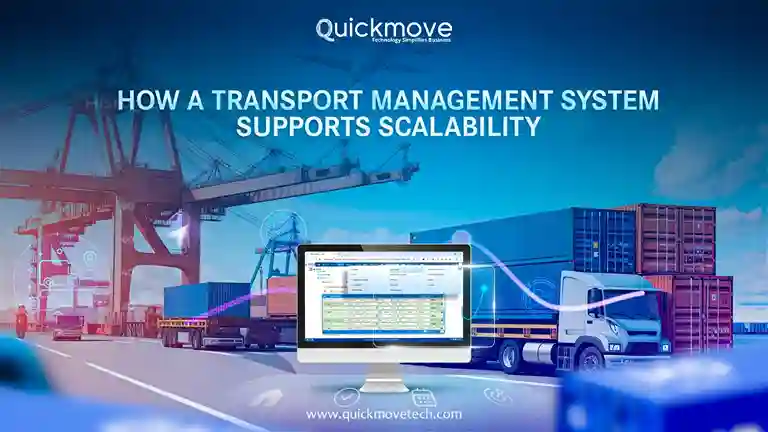
Growth sounds exciting in logistics—more orders, more customers, more deliveries, and bigger opportunities. But anyone who has managed transport operations knows that growth also creates pressure.
What works for handling 50 shipments a day may completely fail when the number becomes 500.
Suddenly:
- Dispatch teams struggle to keep up
- Drivers miss schedules
- Communication gaps increase
- Costs become harder to control
- Customer complaints start rising
This is why scalability matters.
A business is only truly scalable when it can grow without losing efficiency, visibility, or control. And in modern logistics, one of the most important tools for achieving this is a transport management system (TMS).
A transport management system helps businesses handle increasing operational complexity without creating chaos. It creates structure, automation, and visibility that support long-term expansion.
Let’s explore how a transport management system supports scalability and why it has become essential for growing logistics operations.
What Scalability Means in Logistics
Scalability is not simply about handling more shipments.
True scalability means:
- Managing higher order volumes smoothly
- Expanding into new regions without disruption
- Increasing fleet size efficiently
- Maintaining delivery quality during growth
- Keeping operational costs under control
Many businesses grow quickly but struggle operationally because their systems are not built to scale.
Manual processes may work during the early stages of business. But as operations expand, those same processes become bottlenecks.
This is where a transport management system becomes critical.
The Challenges of Scaling Logistics Operations
Before understanding how a TMS helps, it’s important to look at the common challenges businesses face during expansion.
Increasing Shipment Volumes
As orders increase:
- Planning becomes more complex
- Manual tracking becomes difficult
- Errors increase
Without proper systems, teams become overwhelmed very quickly.
Growing Fleet Management Complexity
Managing five vehicles is very different from managing fifty.
As fleets expand:
- Maintenance scheduling becomes harder
- Driver coordination becomes more complicated
- Fuel monitoring becomes difficult
Without centralized visibility, inefficiencies grow rapidly.
Rising Customer Expectations
Growth also brings pressure from customers.
Clients now expect:
- Faster deliveries
- Real-time tracking
- Accurate ETAs
- Quick issue resolution
Scaling without maintaining service quality can damage customer trust.
Operational Communication Gaps
As teams grow larger, communication becomes harder.
Different departments may struggle with:
- Data inconsistencies
- Delayed updates
- Coordination problems
These gaps slow down operations and reduce productivity.
How a Transport Management System Supports Scalability
A transport management system helps businesses grow in a structured and manageable way.
Instead of adding more manual effort every time operations expand, the system automates and organizes core processes.
Let’s break down the key benefits.
1. Automation Reduces Operational Pressure
One of the biggest scalability advantages of a transport management system is automation.
As order volumes increase, manual tasks become impossible to manage efficiently.
A TMS automates:
- Order processing
- Shipment allocation
- Route planning
- Delivery status updates
- Documentation workflows
This means your team can manage significantly larger workloads without increasing stress or confusion.
Instead of hiring large numbers of people for repetitive tasks, businesses can scale efficiently with automation.
Solutions like QuickMove Technologies transport management system help businesses automate critical transport workflows so operations remain organized even during rapid growth.
2. Centralized Visibility Across Operations
Scalability becomes difficult when information is scattered across spreadsheets, phone calls, and separate systems.
A transport management software creates a centralized platform where businesses can monitor:
- Shipments
- Vehicles
- Drivers
- Delivery timelines
- Operational performance
This visibility becomes extremely important as operations grow across multiple regions or teams.
Managers no longer need to rely on fragmented communication to understand what’s happening.
Instead, they can make faster and more accurate decisions using real-time information.
3. Better Route Optimization for Larger Networks
As delivery volumes increase, route planning becomes more complex.
Without automation:
- Fuel costs increase
- Delivery delays become common
- Vehicles are underutilized
A transport management system uses route optimization to:
- Identify the fastest routes
- Reduce empty miles
- Improve multi-stop planning
- Balance workloads across vehicles
This allows businesses to expand delivery operations without increasing transportation costs unnecessarily.
Scalability is not just about moving more shipments—it’s about doing it efficiently.
4. Easier Fleet Expansion
Growing logistics businesses eventually need larger fleets.
But managing additional vehicles manually creates operational complexity very quickly.
A TMS simplifies fleet management through:
- Vehicle tracking
- Maintenance scheduling
- Driver assignment
- Fuel monitoring
This helps businesses expand fleets while maintaining operational control.
Instead of creating confusion, fleet growth becomes structured and manageable.
5. Consistent Customer Experience During Growth
Many businesses lose service quality as they scale.
Late deliveries, communication delays, and tracking issues become more common when systems are not prepared for growth.
A transport management system helps maintain customer satisfaction by providing:
- Real-time shipment updates
- Accurate delivery timelines
- Faster issue resolution
- Better communication workflows
This consistency is essential for long-term growth.
Customers may tolerate occasional issues from small businesses. But larger operations are expected to deliver reliable service consistently.
QuickMove Technologies software for transport management helps growing logistics businesses maintain delivery visibility and operational consistency even as shipment volumes increase.
6. Reduced Dependency on Manual Coordination
Manual coordination works only up to a certain point.
As businesses scale:
- Calls increase
- Emails multiply
- Miscommunication becomes frequent
A TMS reduces dependency on manual communication by centralizing workflows and automating updates.
Teams can access shared information instantly instead of relying on constant follow-ups.
This significantly improves operational speed and efficiency.
7. Data-Driven Decision Making
Growth without data often leads to poor decisions.
A transport management system provides insights into:
- Delivery performance
- Cost trends
- Driver productivity
- Fleet utilization
- Shipment bottlenecks
This helps businesses:
- Identify operational weaknesses
- Improve resource allocation
- Make smarter expansion decisions
Scalable businesses rely heavily on operational data to maintain efficiency.
8. Simplified Multi-Location Management
As businesses expand geographically, managing operations across multiple locations becomes challenging.
Without centralized systems:
- Coordination becomes difficult
- Data visibility decreases
- Standardization becomes impossible
A transport management system helps businesses manage:
- Multiple warehouses
- Regional delivery hubs
- Different transport teams
All from a single platform.
This creates operational consistency across locations.
9. Better Resource Utilization
Scalability is not just about adding more resources. It’s also about using existing resources more effectively.
A TMS improves:
- Vehicle utilization
- Driver scheduling
- Shipment consolidation
- Route efficiency
This helps businesses grow without increasing operational costs at the same pace.
Better utilization directly improves profitability during expansion.
10. Faster Onboarding of Teams and Drivers
Growing businesses often need to hire new employees and drivers quickly.
Complicated systems make onboarding difficult and slow.
A user-friendly transport management system simplifies:
- Training
- Workflow understanding
- Task execution
This helps businesses scale teams more efficiently.
QuickMove Technologies transport management system is designed with operational simplicity in mind, helping teams adapt quickly without lengthy learning curves.
11. Improved Compliance Management
As logistics operations expand, compliance requirements become more difficult to manage manually.
Businesses may need to track:
- Delivery records
- Driver documentation
- Regulatory requirements
- Vehicle compliance
A TMS organizes documentation and automates compliance-related workflows.
This reduces risk while supporting operational growth.
12. Stronger Financial Control During Expansion
Growth can increase revenue, but it can also increase waste if costs are not managed carefully.
A transport management system helps businesses monitor:
- Fuel expenses
- Delivery costs
- Vehicle performance
- Billing accuracy
This financial visibility becomes increasingly important as operations scale.
Without cost control, growth may increase revenue without improving profitability.
13. Scalability Without Operational Chaos
One of the biggest advantages of a transport management system is structure.
When businesses grow without proper systems:
- Teams become reactive
- Problems multiply
- Efficiency drops
A TMS creates standardized workflows that keep operations stable during expansion.
This stability is what allows businesses to scale confidently.
Why Scalable Logistics Operations Need Technology
In today’s logistics environment, manual operations simply cannot support large-scale growth effectively.
The industry is becoming:
- Faster
- More competitive
- More customer-driven
- More data-focused
Businesses that rely entirely on spreadsheets and manual coordination often struggle to keep up.
Technology is no longer optional for scalability—it’s essential.
That’s why many growing logistics businesses invest in solutions like QuickMove Technologies transport management system to build a stronger operational foundation before expansion creates complexity.
Choosing the Right Transport Management System for Scalability
Not every transport management system supports growth effectively.
A scalable TMS should offer:
- Automation capabilities
- Real-time visibility
- Route optimization
- Fleet management tools
- Easy integration with existing systems
- User-friendly workflows
Most importantly, it should be flexible enough to adapt as your business grows.
QuickMove Technologies transport management system is designed to support businesses at different stages of growth by helping them simplify transport operations while improving visibility and operational efficiency.
Common Signs Your Business Needs a Scalable TMS
Many businesses wait too long before upgrading their systems.
Here are some signs that scalability is becoming a challenge:
- Teams are overwhelmed with manual tasks
- Delivery delays are increasing
- Communication gaps are becoming frequent
- Operational costs are difficult to control
- Visibility across operations is poor
- Customer complaints are rising during growth
If these issues sound familiar, it may be time to invest in a transport management system built for expansion.
The Long-Term Impact of Scalability
Scalability affects more than operational efficiency.
It impacts:
- Customer retention
- Profit margins
- Team productivity
- Brand reputation
- Business stability
Companies that scale efficiently are better positioned for long-term success.
And businesses that fail to scale properly often struggle with rising costs and declining service quality.
Final Thoughts
Growth in logistics is exciting, but it also creates complexity.
Without the right systems in place, scaling operations can quickly lead to inefficiencies, communication gaps, and operational confusion.
A transport management system helps businesses grow in a structured, efficient, and sustainable way.
By improving automation, visibility, coordination, and operational control, a TMS allows logistics companies to handle increasing workloads without losing efficiency.
The result is:
- Better operational stability
- Improved customer service
- Stronger profitability
- Faster decision-making
- Sustainable business growth
Modern logistics businesses cannot rely on manual operations forever. Scalability requires technology, organization, and visibility.
And a transport management system is one of the most important tools for making that growth manageable.
As the logistics industry continues to evolve, businesses that invest in scalable systems today will be far better prepared for tomorrow’s demands.