Email Us

 Freight Forwarding Software
 Warehouse Management System
 Transport Management System
 Moving/Removal Software
 Customer Service Portal
 Move Survey Quote Pro
 Digital Logistics Inventory App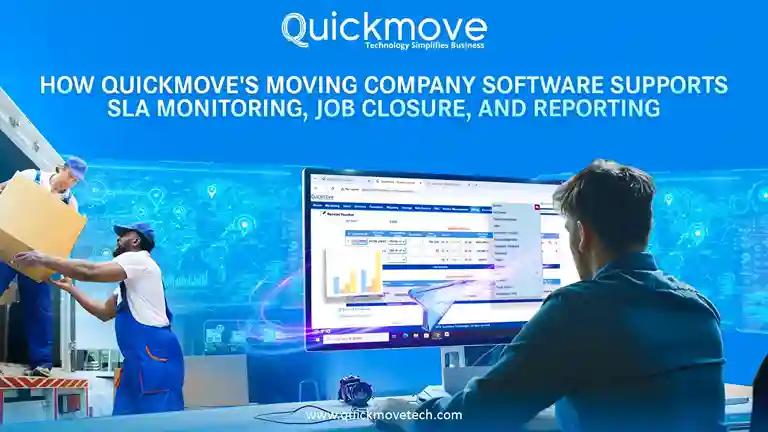
In the moving industry, the job is not really finished when the truck is unloaded and the crew drives away. For customers, the real judgment happens afterward: Was the move on time? Was anything damaged? Were promises kept? Did the mover follow the service agreement?
For moving companies, this final phase is where Service Level Agreements (SLAs), job closure, and reporting come into play. And this is also where many businesses struggle.
Paper checklists go missing. Damage reports arrive days late. Job statuses are unclear. Managers chase updates across phone calls, WhatsApp messages, and spreadsheets. By the time a client asks for performance data, the team is scrambling.
This is exactly the gap that QuickMove’s moving company software is designed to close.
In this blog post, we’ll break down — in clear, practical terms — how QuickMove helps moving companies:
- Monitor SLAs in real time
- Close jobs properly and consistently
- Generate accurate, useful reports for clients and internal teams
Why SLA Monitoring Matters More Than Ever in the Moving Industry
SLAs used to be something only large corporate relocation contracts talked about. Today, they are becoming standard across:
- Corporate moves
- Government contracts
- International relocations
- Enterprise accounts
- High-value residential moves
An SLA may include commitments such as:
- Delivery within a defined time window
- Use of trained crews
- Damage reporting within 24 hours
- Complete unpacking and debris removal
- Customer sign-off at job completion
If these commitments are not tracked properly, two things happen:
- Clients lose trust
- Disputes become harder to resolve
QuickMove’s moving company software treats SLA monitoring as part of the workflow, not an afterthought.
Turning SLAs into Trackable Tasks with Moving Company Software
One of the biggest problems with SLAs is that they often live in contracts, not in day-to-day operations.
QuickMove solves this by embedding SLA requirements directly into the job lifecycle.
How This Works in Practice
When a job is created in QuickMove:
- SLA parameters can be linked to the job type or client
- Required milestones are defined upfront
- Time-based expectations are automatically tracked
For example:
- Delivery must be completed by 4 PM
- Damage photos must be captured before crew departure
- Job sign-off must be completed on-site
The software doesn’t rely on memory or manual reminders. It tracks progress as the job moves forward.
This makes SLA compliance visible — not just to managers, but also to crews and coordinators.
Real-Time Visibility Instead of End-of-Month Surprises
Traditional SLA tracking often happens after the job is done — when it’s already too late to fix issues.
QuickMove’s moving company software provides real-time visibility into job performance.
Operations teams can see:
- Which jobs are on track
- Which tasks are incomplete
- Where delays are happening
- Which SLAs are at risk
This allows teams to act early.
If unloading is taking longer than planned, extra crew support can be arranged.
If documentation is missing, crews can be prompted before leaving the site.
This shift — from reactive to proactive — is one of the biggest advantages of using purpose-built moving software.
Job Closure: Why Done Is Not Enough
Many moving companies consider a job closed when the truck is empty and payment is received. But from an operational and contractual standpoint, that’s often incomplete.
Proper job closure should include:
- Confirmation of all services delivered
- Damage or exception reporting
- Customer acknowledgment
- Final documentation
- Internal review readiness
QuickMove’s moving company software enforces structured job closure so nothing slips through.
Standardized Job Closure Across Every Move
One of the challenges growing moving companies face is inconsistency.
Different crews close jobs differently.
Different branches use different methods.
Different clients expect different reports.
QuickMove standardizes job closure through defined workflows.
Before a job can be marked complete, the system ensures:
- Required tasks are completed
- Mandatory fields are filled
- Supporting evidence (photos, notes) is attached
- Signatures or acknowledgements are captured
This creates a consistent close-out process across the entire organization — regardless of location or job type.
On-Site Confirmation with Digital Sign-Off
Job disputes often come down to one question: Did the customer approve this?
QuickMove’s moving company software supports digital job sign-off at the destination.
Customers or client representatives can:
- Review completed services
- Acknowledge delivery and condition
- Confirm unpacking or reinstatement
- Sign directly on the device
This removes ambiguity and creates a clear record of acceptance.
For corporate and government clients, this documentation is often mandatory — and having it captured immediately reduces follow-up work later.
Capturing Exceptions Without Slowing Down Crews
Not every move goes perfectly. Damage happens. Access issues arise. Timelines shift.
The problem isn’t that issues occur — it’s that they are often poorly documented.
QuickMove makes exception capture part of the job closure flow.
Crews can:
- Record damage or issues in real time
- Take photos directly within the job
- Add notes while details are fresh
- Tag issues to specific inventory items or tasks
This information becomes part of the job record automatically.
No separate forms. No delayed emails. No missing details.
SLA Monitoring Meets Claims and Exceptions
SLA compliance isn’t only about speed — it’s also about response.
Many SLAs require:
- Damage reported within a specific timeframe
- Evidence attached
- Acknowledgement sent to the client
Because QuickMove links job closure, claims capture, and SLA tracking, teams can clearly see whether these commitments were met.
This protects the moving company during disputes and strengthens client relationships.
Reporting: Turning Operational Data into Useful Insights
Most moving companies collect data. Very few use it effectively.
QuickMove’s moving software turns daily job data into clear, usable reports.
These reports are designed for real business needs — not just dashboards that look impressive.
SLA Performance Reporting Clients Actually Understand
Corporate and enterprise clients don’t want raw data dumps. They want clear answers:
- Were SLAs met?
- Where were there exceptions?
- How often do issues occur?
- Is performance improving over time?
QuickMove allows teams to generate SLA-focused reports that show:
- On-time delivery rates
- Completion of required services
- Damage incidence
- Response times
These reports can be shared with clients during reviews or audits, reinforcing transparency and professionalism.
Internal Reporting for Better Decision-Making
Reporting isn’t just for clients. It’s just as important internally.
QuickMove helps operations managers and leadership teams identify patterns such as:
- Which crews consistently meet SLAs
- Which routes or locations face delays
- Where job closures are incomplete
- Which clients require additional support
Instead of relying on gut feeling, decisions can be based on real performance data.
Reducing Manual Work and Reporting Errors
Manual reporting is slow and error-prone.
When teams rely on spreadsheets or handwritten notes, mistakes are inevitable. Numbers don’t match. Information is missing. Time is wasted reconciling data.
Because QuickMove captures information as part of the workflow, reports are generated from live operational data.
This means:
- Fewer errors
- Faster report generation
- Less administrative overhead
Staff spend less time preparing reports and more time improving service.
Supporting Audits and Compliance with Confidence
For moving companies working with large enterprises, government bodies, or international partners, audits are a reality.
QuickMove’s moving software creates a complete digital audit trail for every job.
This includes:
- Time-stamped activities
- Crew actions
- Photo evidence
- Sign-offs
- SLA tracking
When auditors or clients request documentation, it’s available in one place — not scattered across emails and folders.
This level of traceability builds trust and reduces risk.
Building Trust Through Consistency and Transparency
At its core, SLA monitoring, job closure, and reporting are not just about internal control. They are about trust.
Clients want to work with moving companies that:
- Do what they promise
- Communicate clearly
- Take responsibility
- Provide evidence, not excuses
QuickMove supports this by making performance visible and verifiable.
When clients see structured reports, timely documentation, and consistent processes, confidence grows — and long-term relationships follow.
Experience Matters: Built for Real Moving Operations
What makes QuickMove’s moving company software effective is that it reflects how moving companies actually work.
It understands that:
- Crews are busy and need simple tools
- Managers need visibility, not complexity
- Clients want clarity, not jargon
The system doesn’t add layers of work — it replaces inefficient ones.
This practical, experience-driven approach is what allows SLA monitoring, job closure, and reporting to happen naturally within operations.
Why This Matters for Growing Moving Companies
As moving companies scale, problems don’t grow linearly — they multiply.
More jobs mean:
- More SLAs to track
- More clients to report to
- More opportunities for things to go wrong
Without the right moving company software, growth creates chaos.
QuickMove provides the structure needed to scale without losing control, quality, or credibility.
Final Thoughts
SLA monitoring, job closure, and reporting are often treated as administrative tasks. In reality, they are core business functions that directly affect reputation, profitability, and client retention.
QuickMove’s moving company software brings these functions together into one connected workflow.
By doing so, it helps moving companies:
- Stay accountable
- Reduce disputes
- Improve performance
- Build stronger client relationships
And most importantly, it ensures that when a job is marked “complete,” it truly is — for the mover and the customer alike.