Email Us
 Freight Forwarding Software
 Warehouse Management System
 Transport Management System
 Moving/Removal Software
 Customer Service Portal
 Move Survey Quote Pro
 Digital Logistics Inventory App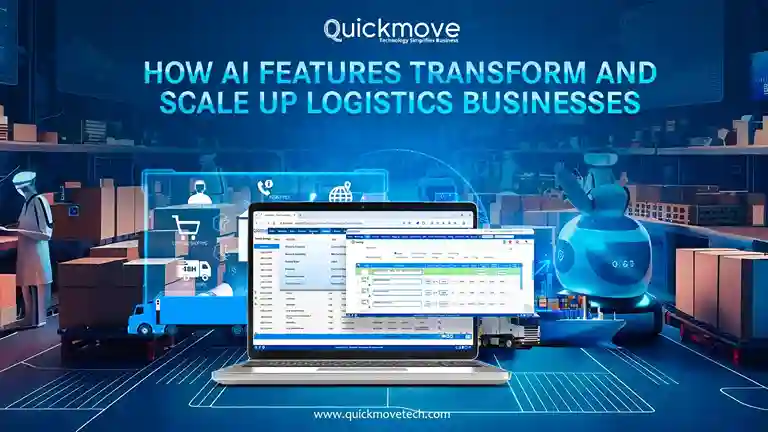
The logistics industry is changing faster than ever. What used to depend heavily on manual processes, spreadsheets, and constant follow-ups is now being reshaped by intelligent systems that can think, learn, and act. Artificial Intelligence (AI) is no longer a “nice-to-have” in logistics—it has become a core driver of growth, efficiency, and scalability.
If you run or manage a logistics business, you already know the daily challenges: delayed shipments, rising operational costs, miscommunication between teams, invoice errors, and unpredictable demand. These issues don’t just slow you down—they limit your ability to grow.
This is exactly where AI-powered logistics software is making a real difference.
In this blog, we’ll break down how AI features are transforming logistics businesses in practical, real-world ways—and how solutions like QuickMove’s AI-powered logistics software are helping companies scale faster without increasing complexity.
The Current Challenges in Logistics
Before we talk about transformation, it’s important to understand the problems AI is solving.
Most logistics businesses struggle with:
- Manual data entry and human errors
- Lack of real-time visibility across operations
- Poor coordination between vendors, warehouses, and fleets
- Inefficient route planning and delivery delays
- Invoice mismatches and financial discrepancies
- Difficulty in scaling operations without increasing manpower
These challenges don’t just affect efficiency—they impact customer trust and profitability.
Traditional systems try to fix these problems with more processes. AI solves them by making systems smarter.
What Does AI in Logistics Actually Mean?
When we talk about AI in logistics, we’re not referring to robots taking over warehouses (though that’s part of it). We’re talking about software that can:
- Analyze large volumes of data instantly
- Learn from patterns and past behavior
- Predict outcomes and suggest actions
- Automate repetitive tasks
- Improve decision-making in real time
In simple terms, AI helps your logistics system think ahead instead of reacting late.
1. AI-Powered Automation of Routine Operations
One of the biggest transformations AI brings is automation.
The Problem:
Many logistics operations still depend on manual work:
- Creating invoices
- Updating shipment statuses
- Assigning tasks to vendors
- Entering data into multiple systems
This leads to delays and frequent errors.
The AI Solution:
AI automates these repetitive tasks with precision.
For example:
- Automatically generating invoices based on completed services
- Extracting data from documents without manual input
- Updating shipment milestones in real time
- Assigning jobs to vendors based on availability and performance
Real Impact:
- Faster processing times
- Reduced human errors
- Less dependency on manual workforce
- More time for teams to focus on strategic work
QuickMove’s logistics software uses intelligent automation to streamline these operations, ensuring that your business runs smoothly even during peak loads.
2. Smart Vendor and Resource Management
Managing vendors, drivers, and service providers can get complicated, especially when your business grows.
The Problem:
- No clear visibility of vendor performance
- Difficulty in choosing the right vendor for each job
- Over-reliance on manual coordination
The AI Solution:
AI systems analyze vendor data such as:
- Past performance
- Delivery timelines
- Cost efficiency
- Service quality
Based on this, the system can automatically suggest or assign the best vendor for each task.
Real Impact:
- Better decision-making
- Improved service quality
- Reduced operational delays
- Stronger vendor relationships
Instead of guessing, you make data-backed decisions every time.
3. Intelligent Route Optimization
Route planning is one of the most critical aspects of logistics—and also one of the most inefficient when done manually.
The Problem:
- Traffic conditions change constantly
- Delivery priorities shift
- Manual planning leads to longer routes and delays
The AI Solution:
AI-powered systems analyze:
- Real-time traffic data
- Weather conditions
- Delivery urgency
- Vehicle capacity
They then generate the most efficient routes automatically.
Real Impact:
- Faster deliveries
- Reduced fuel costs
- Better resource utilization
- Higher customer satisfaction
With AI, route planning becomes dynamic—not static.
4. Predictive Analytics for Better Planning
One of AI’s most powerful capabilities is prediction.
The Problem:
Logistics businesses often react to problems instead of preventing them:
- Sudden demand spikes
- Stock shortages
- Delivery delays
The AI Solution:
AI analyzes historical data and trends to predict:
- Future demand
- Peak seasons
- Potential delays
- Inventory requirements
Real Impact:
- Better planning and preparedness
- Reduced disruptions
- Improved inventory management
- Smarter business decisions
QuickMove’s AI-driven analytics helps logistics companies move from reactive operations to proactive planning.
5. Automated Invoice Processing and Financial Accuracy
Financial operations in logistics are often complex, involving multiple vendors, services, and cost structures.
The Problem:
- Manual invoice creation
- Frequent mismatches and errors
- Delays in approvals and payments
The AI Solution:
AI can:
- Automatically generate invoices based on services, assets, and consumables
- Validate invoice data against contracts and operations
- Detect discrepancies instantly
Real Impact:
- Faster billing cycles
- Improved financial accuracy
- Reduced disputes with vendors
- Better cash flow management
QuickMove’s AI-powered invoice processing module ensures that your financial operations are just as efficient as your logistics operations.
6. Real-Time Visibility and Control
Visibility is the backbone of efficient logistics.
The Problem:
Without real-time updates:
- Teams operate in silos
- Customers lack transparency
- Issues are identified too late
The AI Solution:
AI integrates data from multiple sources to provide:
- Real-time shipment tracking
- Live updates on operations
- Alerts for delays or issues
Real Impact:
- Better coordination between teams
- Increased customer trust
- Faster issue resolution
- Complete operational control
You don’t just see what’s happening—you understand what needs to be done next.
7. Enhanced Customer Experience
Customer expectations in logistics are higher than ever.
The Problem:
- Delayed updates
- Lack of communication
- Uncertain delivery timelines
The AI Solution:
AI enables:
- Automated customer notifications
- Accurate delivery predictions
- Quick issue resolution
Real Impact:
- Improved customer satisfaction
- Increased retention
- Stronger brand reputation
When customers feel informed and confident, they stay loyal.
8. Scalability Without Chaos
Scaling a logistics business traditionally means hiring more people, adding more processes, and increasing complexity.
The Problem:
Growth often leads to:
- Operational bottlenecks
- Communication gaps
- Increased costs
The AI Solution:
AI systems scale effortlessly because they:
- Handle increasing data volumes
- Automate additional workloads
- Maintain consistency across operations
Real Impact:
- Smooth business expansion
- Controlled operational costs
- Consistent service quality
QuickMove’s AI-powered logistics software is built to support growing businesses without adding operational chaos.
9. Data-Driven Decision Making
In logistics, decisions are often made based on experience or intuition.
The Problem:
- Lack of accurate data insights
- Delayed reporting
- Inconsistent decision-making
The AI Solution:
AI provides:
- Real-time dashboards
- Performance analytics
- Actionable insights
Real Impact:
- Faster and smarter decisions
- Improved operational efficiency
- Better strategic planning
You move from “guesswork” to “confidence.”
10. Reduced Operational Costs
Every logistics business aims to reduce costs while maintaining quality.
The Problem:
- Fuel wastage
- Inefficient resource utilization
- Manual errors leading to financial losses
The AI Solution:
AI optimizes:
- Routes
- Resource allocation
- Inventory management
- Workforce efficiency
Real Impact:
- Lower operational expenses
- Higher profit margins
- Sustainable business growth
AI doesn’t just improve efficiency—it directly impacts your bottom line.
Why AI is No Longer Optional
If you’re still relying on traditional systems, you may be managing—but you’re not scaling.
The logistics industry is becoming more competitive every day. Businesses that adopt AI are able to:
- Deliver faster
- Operate more efficiently
- Provide better customer experiences
- Scale without increasing costs
Those that don’t risk falling behind.
How QuickMove is Leading the AI Transformation
QuickMove’s AI-powered logistics software is designed specifically for modern logistics businesses that want to grow without limits.
It combines:
- Intelligent automation
- Predictive analytics
- Real-time visibility
- Smart financial processing
- Scalable architecture
What makes it different is its focus on real operational challenges—not just theoretical features.
Instead of overwhelming you with complexity, it simplifies your workflows while making them smarter.
Real-World Example: Scaling with AI
Let’s consider a growing logistics company managing multiple warehouses and vendors.
Before AI:
- Manual invoice processing
- Frequent delivery delays
- Poor vendor coordination
- Limited visibility
After Implementing AI (with QuickMove):
- Automated invoicing reduces processing time by 70%
- Route optimization cuts delivery delays significantly
- Vendor selection becomes data-driven
- Real-time dashboards improve operational control
Result:
The company scales its operations by 2x without doubling its workforce.
That’s the power of AI.
Common Misconceptions About AI in Logistics
“AI is too expensive”
In reality, AI reduces costs in the long run by improving efficiency.
“It’s too complex to implement”
Modern AI solutions like QuickMove are designed to be user-friendly and easy to integrate.
“It will replace human jobs”
AI doesn’t replace people—it helps them work smarter and focus on higher-value tasks.
The Future of Logistics with AI
AI in logistics is just getting started.
In the coming years, we can expect:
- Fully autonomous supply chains
- Hyper-personalized customer experiences
- Advanced predictive systems
- Seamless integration across global networks
Businesses that adopt AI early will lead this transformation.
Final Thoughts
AI is not just a technological upgrade—it’s a business transformation.
It changes how you operate, how you make decisions, and how you grow.
For logistics businesses, the benefits are clear:
- Increased efficiency
- Better accuracy
- Lower costs
- Improved customer satisfaction
- Seamless scalability
If your goal is to scale your logistics business without increasing complexity, AI is the way forward.
QuickMove’s AI-powered logistics software is built to make this transition simple, practical, and impactful.